Guide
Discovery Call Screening Questions for Coaches: 13 Questions and What Each One Filters Out
Most advice on screening discovery calls stops at a list of questions. The list is the easy part. What decides whether it works is how you weight the answers and what you do with the score. This guide walks through a real 13 question coaching screen from our free template, explains what each question filters out, and shows how the scoring sends a lead with a great goal but no budget to a nurture step instead of your calendar.
Quick answer
What questions should a coach ask before a discovery call?
Ask about four things: how clear the goal is, how ready the person is to change, when they want to start, and what they can invest in budget, time and approval. Score each answer, count the most important questions double, and send only leads who score well overall and clear a minimum on investment to your booking link. Everyone else gets a next step that is not a call.
What is a discovery call screening question?
A screening question is a question whose answer changes what happens next. "What is your name" is a form field. "Have you set aside a budget for paid help" is a screening question, because a different answer sends the lead somewhere different. Good screens are short, ask about the person's situation instead of their opinion, and offer answers that are easy to tell apart.
The signals that tend to make a call go nowhere are familiar to most coaches: no clear goal, a change someone else is driving, no urgency, and no budget or no say over the budget. The template below tests exactly those four.
How the scoring works in FluoTest
FluoTest is a free scored quiz builder. Every answer carries points in a score category, key questions can count double, and the result is a percentage per category plus an overall score. Outcome rules read those percentages and decide what the person sees and which button they get.
In this template each outcome has its own button. The strong fit outcome carries "Book a discovery call" and you add your own booking link. The other two carry a free starter guide and a newsletter. Unlimited quizzes, responses, score categories and custom outcomes are on the free plan.
Try the template: fluotest.com
The 13 questions and what each one filters out
After one open question, the template has four sections of three questions. Each answer is worth 0 to 10 points, and a question marked x2 counts double. Every category tops out at 40 points, 160 in total.
Your goal
1. In a sentence or two, what would you like help with?
Not scored. It gives you their own words to open the call with, and a vague or empty answer is a signal in itself.
Your goal · x2
2. How would you describe that goal today?
Filters out people who only feel that something should change. A goal with a number or a date scores 10, "I don't have a goal in mind yet" scores 0.
Your goal
3. How many goals would you want to work on at the same time?
Filters out a scope that is too wide for one engagement. One main goal scores 10, several goals in different areas score 3.
Your goal
4. If nothing changes in the next 12 months, what would it cost you?
Filters out low stakes. A cost they can name, like income, health or time, scores 10. "Not much, things are fine as they are" scores 0.
Readiness to change · x2
5. Which best describes where you are with this change?
Filters out people who are still deciding whether to change at all. "I've already started and want support to keep going" scores 10, "I'm not sure anything needs to change" scores 0.
Readiness to change
6. Who is driving this change?
Filters out change that belongs to someone else. "I am, it's my own choice" scores 10, "Mostly someone else, such as my manager or partner" scores 2.
Readiness to change
7. When someone challenges how you do things, what do you usually do?
Filters out people who will not use coaching. "Ask questions and try their idea" scores 10, "Stick with what I know" scores 0.
Timing · x2
8. If we're a good fit, when would you want to start?
Filters out the permanent "just exploring". Within 2 weeks scores 10, no set time scores 0.
Timing
9. How high is this goal on your list of priorities right now?
A 0 to 10 slider that counts at face value. Filters out a goal that is competing with everything else.
Timing
10. What made you start looking for help now?
Filters out curiosity. A specific event, deadline or change scores 10, "Nothing in particular, I'm curious" scores 0.
Your investment · x2
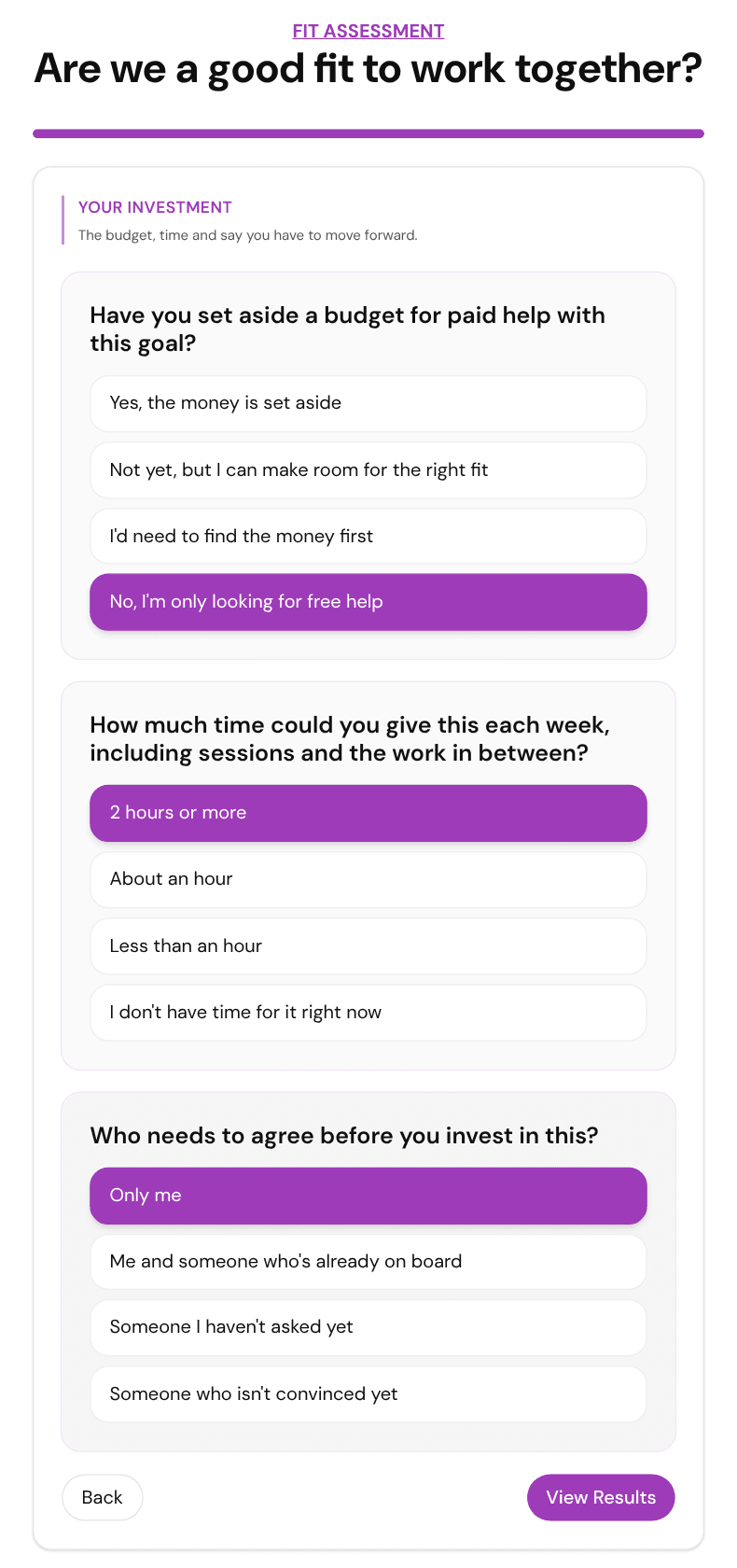
11. Have you set aside a budget for paid help with this goal?
The hardest filter. "Yes, the money is set aside" scores 10, "No, I'm only looking for free help" scores 0.
Your investment
12. How much time could you give this each week, including sessions and the work in between?
Filters out people who cannot do the work between sessions. 2 hours or more scores 10, no time right now scores 0.
Your investment
13. Who needs to agree before you invest in this?
Filters out the call where you pitch someone who cannot say yes. "Only me" scores 10, "Someone who isn't convinced yet" scores 1.
Routing: where each lead goes
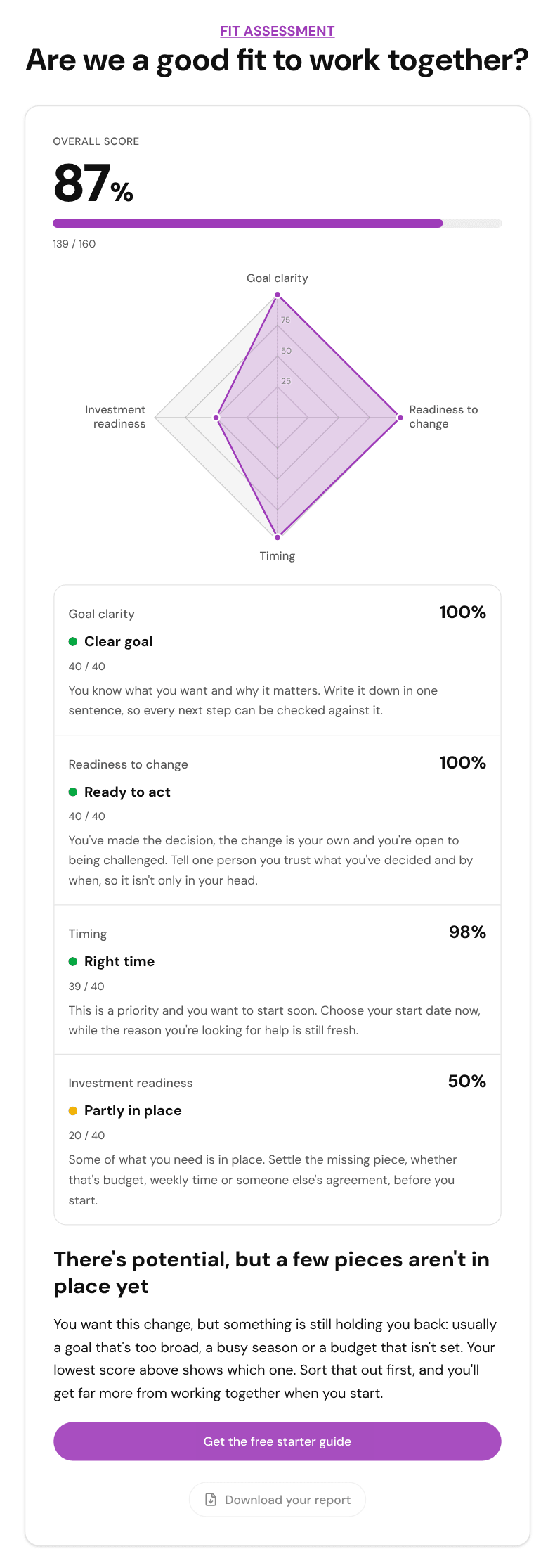
The template has three outcomes, checked in order. Strong fit needs an overall score of at least 70% and at least 55% in the investment category. Potential fit needs at least 40% overall. Everything below that lands on "Not the right time".
The 55% rule is the part most screens skip. The budget question counts double, so a lead who answers "No, I'm only looking for free help" can reach at most 50% on investment, whatever else they say. The screenshots below show that lead: a specific goal, already started, ready within two weeks, two hours a week and nobody else to convince. The overall score is 87%, with goal clarity and readiness at 100% and timing at 98%. Because investment sits at 50%, the result is the nurture outcome with the free starter guide, not the booking link.
You do not have to keep these numbers. If you work with lower priced clients, lower the investment minimum. If every call costs you a lot of time, raise the overall threshold. What matters is that the rule is written down and applied the same way to every lead.
Try the template:
Build your free screening quizHow to build your own screening quiz
1. Start from the template
Open the coaching fit template and use it free. The 13 questions, the weights and the three outcomes come with it, so you edit instead of starting from a blank page.
2. Rewrite the answers in your clients' words
Keep the structure and change the wording to match how your clients talk about their problem. Keep the answer options far enough apart that a respondent can tell them apart.
3. Decide your must haves
Pick the one or two things that rule out a call whatever else is true. For most coaches that is budget. In FluoTest this becomes a minimum percentage on one score category.
4. Set the thresholds
Choose the overall percentage for a strong fit and the one for a potential fit. The template starts at 70 and 40. Adjust them once you have seen real answers.
5. Add your booking link to the strong fit button
The button ships without a link. Add your calendar link to the strong fit outcome and a useful resource to the other two, so nobody hits a dead end.
6. Put the quiz in front of your calendar
Share the link, embed it on your services page or use it instead of a contact form. Turn on the results email so the lead gets their result, and you can read their answers before the call.
7. Review after 30 days
Look at the calls you took. If weak leads still got through, raise a threshold. If you turned away people who would have been a good fit, lower one.
Benefits of screening before the call
- -You open the call already knowing the lead's goal, timing and budget situation.
- -A lead who is not ready gets a next step instead of a rejection.
- -One written rule replaces gut feeling and applies to every lead the same way.
- -A strong goal cannot hide a missing budget, because the minimum is checked separately.
- -Unlimited quizzes and responses on the free plan, so screening costs nothing per lead.
- -The lowest category score tells you what to talk about first.
Who should use a screening quiz
- -Coaches who book discovery calls by hand.
- -Consultants who sell a high touch service and lose hours to calls that go nowhere.
- -Small agencies that want to filter inbound leads on goal, timing and budget.
- -Anyone who sells a service where the first call is expensive and the answer is usually no.
Frequently Asked Questions
How many questions should a discovery call screening form have?
As many as it takes to change the decision, and no more. The template uses 13, including one open question, because it checks four separate things. If a question would not change where a lead goes, remove it.
Should I screen out leads who have no budget?
Screening them out of the call is not the same as dropping them. In the template they go to a free starter guide, so you keep them as a future lead and keep your calendar for people who can say yes today.
Will a screening quiz scare off good leads?
It adds friction, so keep the questions easy to answer and word the result for the respondent, with a clear next step for every outcome. Compare the quality of your calls before and after, and adjust the thresholds.
Can people game the score?
Yes, anyone can pick the best answer every time. The score is a filter, not proof. The open question and the call itself still matter, so compare the score with what you hear live.
Is the coaching fit template free?
Yes. Unlimited quizzes, responses, score categories and custom outcomes are on the free plan. Removing the FluoTest badge is part of Pro at EUR 12 per month.
Build your discovery call screening quiz for free
Start from the coaching fit template and send strong fits straight to your calendar.
What you get with FluoTest:
- - Unlimited quizzes and responses on the free plan
- - All question types
- - Several score categories, weights and minimums per quiz
- - Custom outcomes with their own buttons
- - CSV export of your results
- - Brevo, Zapier, GTM and Meta Pixel integrations
- - Welcome and Thank You pages
Questions? Read our pricing page or browse quiz templates.