Guide
How to Build a Quiz Funnel That Converts
A landing page with a contact form asks for commitment before it has earned any trust. A quiz funnel flips that order: it asks a few low-friction questions first, does the work of figuring out what the visitor actually needs, and only then asks for the email or the booked call, at the exact moment the personalized result makes that ask feel earned. That is why quiz funnels consistently out-convert static forms for lead generation, product recommendations, and gated content. Here is how the stages fit together and how to build each one.
Quick answer
What is a quiz funnel and how do you build one?
A quiz funnel replaces a static landing page or contact form with a short scored quiz: visitors answer a few questions, their answers are scored into a segment, and they land on a personalized result with a conversion action matched to that segment, book a call, get a discount code, join an email sequence. Build one in FluoTest by scoring each answer, writing a personalized outcome per segment, and attaching an action to each outcome.
What Is a Quiz Funnel?
A quiz funnel is a lead generation or sales flow built around a short interactive quiz instead of a static form or landing page. A visitor arrives from an ad, an email, or a link on your site, answers a handful of questions, and their answers are scored to sort them into a segment. Instead of a generic thank-you page, they land on a result written specifically for their segment, paired with a conversion action that matches where they are: book a call, get a personalized recommendation, unlock a discount, or join a nurture sequence.
The mechanism that makes it work is sequence, not novelty. Answering questions is a smaller ask than filling out a form, so more people start. Each answer is a tiny commitment that makes finishing feel natural. And because the result is scored and personalized instead of generic, the final conversion ask lands after the visitor has already told you, through their answers, that they are a fit.
Why Use FluoTest to Build It?
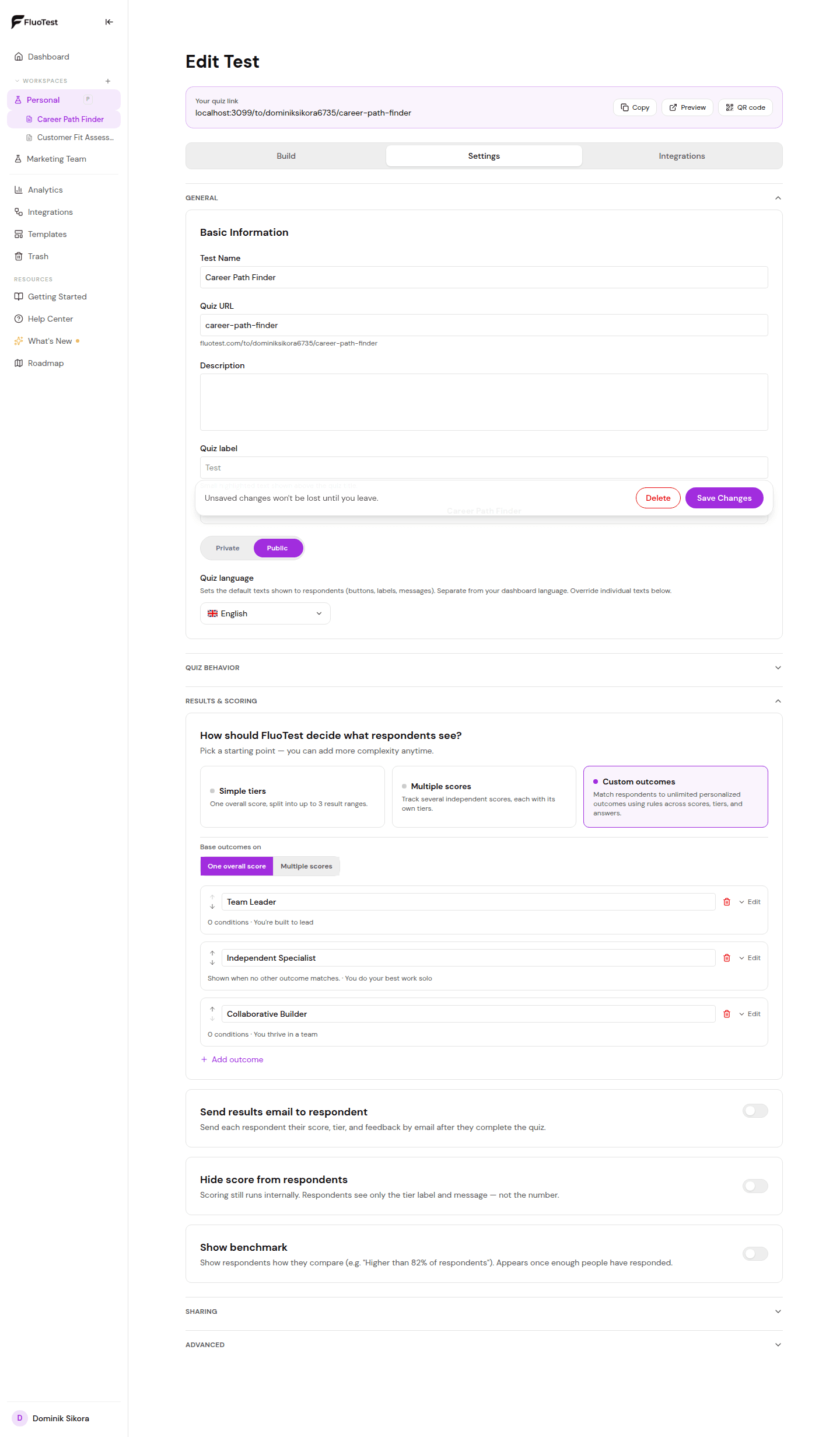
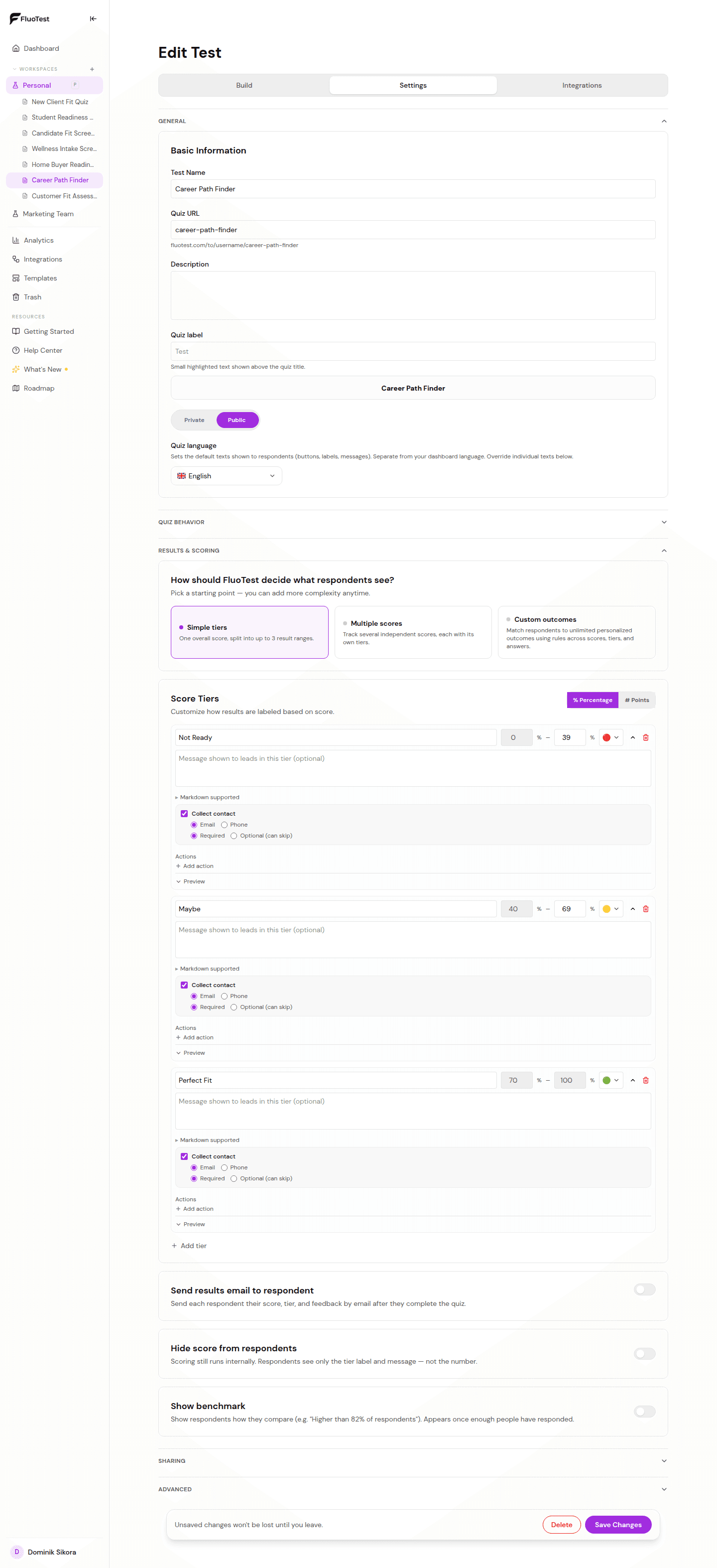
FluoTest is a free quiz builder built for exactly this: score every answer, sort respondents into segments using score ranges or custom rule-based outcomes, and write personalized result copy and a conversion action for each segment, all in the same quiz, no separate landing page tool or automation platform required.
Every submission triggers an email with the full score breakdown, so leads land in your inbox the moment someone finishes. Connect Brevo to sync respondents into segmented email lists based on their result, or use webhooks for Zapier, Make, or n8n to push completed quizzes into your CRM and trigger a follow-up sequence automatically.
Try it: fluotest.com
The 6 Stages of a Quiz Funnel (And How to Build Each One)
1. Get the right traffic to the quiz
A quiz funnel still needs an entry point: a link in an ad, an email, a homepage button, or an embed on a landing page. Frame the link around a question or a benefit, not the word "quiz", for example "Find out which plan fits your team" converts better than "Take our quiz".
2. Design questions that feel like a favor, not a form
Every question should feel like it helps you give a better answer, not like data collection. Keep it to 5 to 10 questions, mix multiple choice with a slider or multi-select to break up the rhythm, and save any contact fields for the end, after the visitor is invested.
3. Score every answer to build the segment
Assign each answer a point value. A single overall score works for a simple funnel, use multiple independent score categories when the segment depends on more than one dimension, for example budget and urgency for a sales-qualification funnel.
4. Write a personalized outcome for each segment
Set score-range tiers or FluoTest's custom outcomes to match respondents to a result written for their specific segment, not a generic thank-you page. Name the result after what the respondent gets, a recommendation, a diagnosis, a plan, not the segment label.
5. Attach a conversion action to each outcome
Match the action to the segment: a high-fit segment gets a "Book a call" button, a not-yet-ready segment gets a gated resource behind an email capture, a browsing segment gets a discount code or a redirect to a relevant product page.
6. Automate what happens after someone finishes
Connect Brevo to add respondents to a segmented email list based on their result, or use a webhook to push the completed quiz into your CRM and trigger a follow-up sequence automatically, so the funnel keeps working after the quiz ends.
Why a Quiz Funnel Converts Better Than a Static Form
- -Lower friction to start: answering a question feels easier than filling out a form
- -Each answer is a small commitment that builds momentum toward finishing
- -The result is personalized to the respondent's answers instead of a generic thank-you page
- -The conversion ask lands after the visitor has shown they are a fit, not before
- -Segmented follow-up means every lead gets a next step that matches where they are
- -One quiz replaces a landing page, a form, and a manual segmentation step
Who Should Build a Quiz Funnel?
- -Coaches and consultants qualifying and segmenting leads before a discovery call
- -SaaS and product marketers matching visitors to the right plan or use case
- -E-commerce and DTC brands building product-recommendation funnels
- -Course creators and info-product sellers segmenting an audience before a launch
- -Agencies building lead-gen funnels for clients without stitching together separate tools
Frequently Asked Questions
How is a quiz funnel different from a regular quiz?
A regular quiz just shows a result. A quiz funnel is built around a conversion goal from the start, every question, score, and outcome is designed to move the respondent toward a specific next action, not just entertain or inform them.
How many questions should a quiz funnel have?
5 to 10 works for most funnels. Enough to score a meaningful segment, short enough that people finish. Save any required contact fields for the end so they do not add friction before the visitor is invested.
Do I need separate tools for the quiz, the scoring, and the email follow-up?
No. FluoTest handles the quiz, the scoring, the personalized outcomes, and the conversion actions in one place, and connects directly to Brevo or webhooks for the follow-up, so you are not stitching together a form builder, a spreadsheet, and an email tool.
What is a good conversion action for a low-intent segment?
Do not ask a cold segment to book a call. Gate a useful resource behind an email capture, or offer a discount code, something low-commitment that keeps them in your funnel for a nurture sequence instead of asking for more than they are ready to give.
Is FluoTest free to use for this?
Yes. FluoTest is free forever with no submission limits, no quiz limits, and no credit card required.
Ready to build your quiz funnel?
FluoTest is free. No credit card required. Start in 5 minutes.
What you get with FluoTest:
- - Weighted scoring across multiple question types
- - Score-range and rule-based custom outcomes per segment
- - Conversion actions per outcome: CTAs, redirects, embeds, contact capture
- - Brevo integration: auto-sync respondents into segmented lists
- - Webhooks for Zapier, Make, and n8n
- - Per-question drop-off analytics
Questions? Read our pricing page or browse quiz templates.