Guide
Free Attachment Style Quiz: Secure, Anxious, Avoidant or Fearful-Avoidant?
Most attachment style quizzes ask a few questions and hand you a label. This one scores two things separately, anxiety and avoidance, from 12 questions about how you act when someone is distant, how much reassurance you need and how comfortable you are depending on others. The result shows both scores as percentages, each with a Low, Moderate or High tier, and the combination decides whether you lean Secure, Anxious, Avoidant or Fearful-Avoidant. Below you can take it for free, read where the four styles come from, see exactly how the points work, and build your own branded version if you coach, counsel or create relationship content.
Quick answer
Where can I take a free attachment style quiz?
FluoTest has a free 12-question attachment style quiz that scores anxiety and avoidance as two separate categories and gives you one of four results: Secure, Anxious, Avoidant or Fearful-Avoidant. It takes about two minutes and needs no account. It is a self-reflection tool based on attachment theory, not a clinical assessment or diagnosis. Coaches, therapists and course creators can duplicate the template for free and change the questions, branding and follow-up.
Take the free attachment style quiz
What Is an Attachment Style Quiz?
An attachment style quiz asks how you behave in close relationships: whether you worry that people will leave, whether closeness starts to feel like pressure, and how you handle conflict and distance. The answers are scored on two dimensions. Attachment anxiety is how much you worry about being rejected or not mattering enough. Attachment avoidance is how uncomfortable you are with depending on someone and letting them get close.
A scored quiz adds points to each dimension separately and shows both totals. That matters because the four styles are not four boxes, they are four corners of the same two scales. Low anxiety plus low avoidance reads as Secure. High anxiety on its own reads as Anxious, high avoidance on its own as Avoidant, and high on both as Fearful-Avoidant. A quiz that only prints a label hides where you actually sit on each scale.
Where the Four Attachment Styles Come From
Attachment theory started with John Bowlby, who described the bond between infants and caregivers as a survival system. Mary Ainsworth's Strange Situation studies in the 1970s observed how one-year-olds reacted when a parent left and came back, and described three patterns: secure, anxious-ambivalent and avoidant. Mary Main and Judith Solomon added a fourth, disorganized, in 1986. In 1987 Cindy Hazan and Phillip Shaver showed that adults describe their romantic relationships in the same three patterns, which is why attachment styles are now discussed in dating and couples contexts.
The two-score approach this quiz uses comes from Kelly Brennan, Catherine Clark and Phillip Shaver, whose 1998 Experiences in Close Relationships questionnaire reduced dozens of attachment measures to two dimensions: anxiety and avoidance. This quiz borrows that structure with 12 plain-language questions. It is a self-reflection tool, not the ECR itself and not a clinical assessment. Attachment patterns can also shift between relationships and over time, so treat the result as a starting point for a conversation, not a verdict.
The Four Results and What They Mean
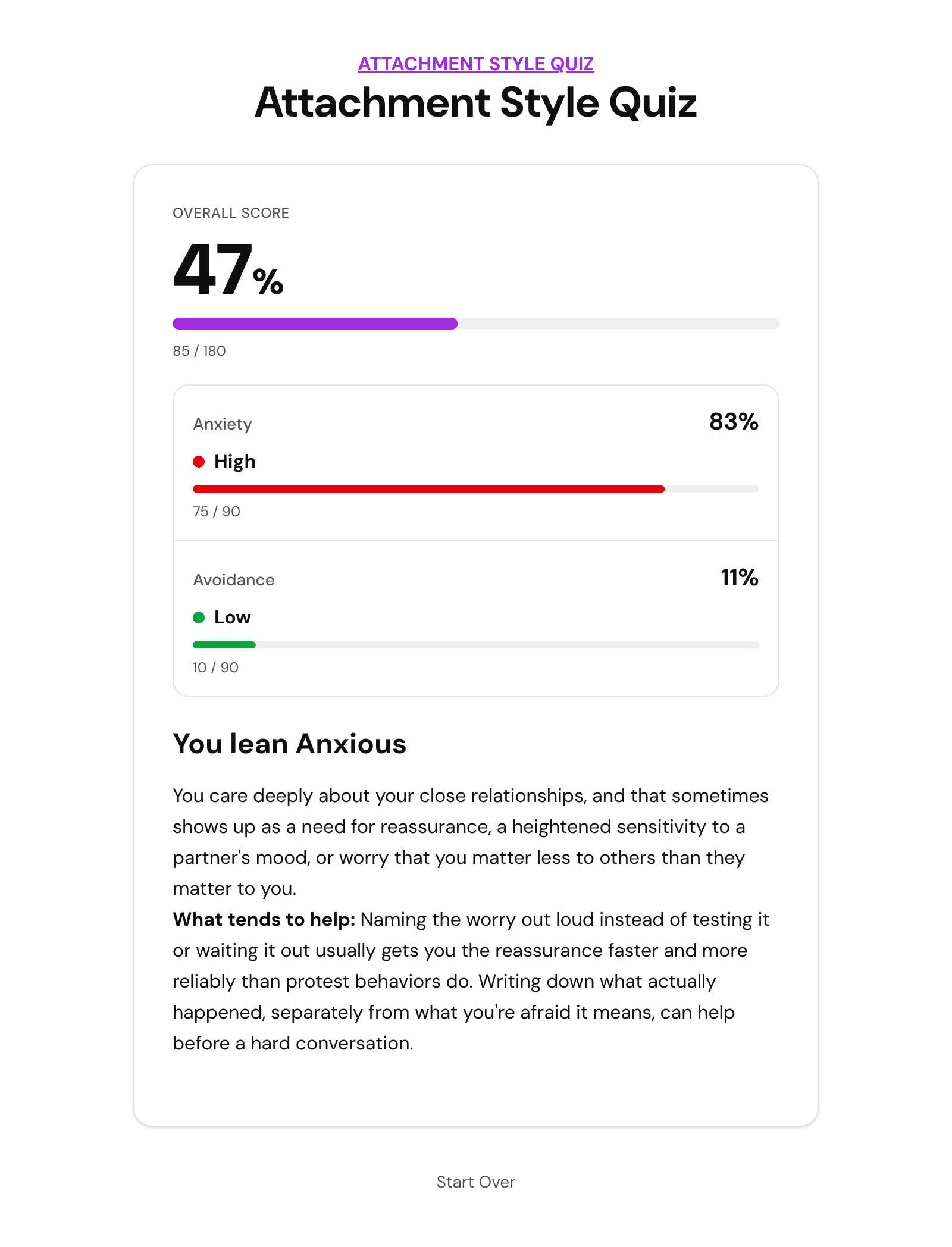
Each score runs from 0 to 100 percent. You get a result when both scores land clearly on one side of 50 percent. If the answers do not fit any of the four combinations, the quiz shows a fifth, default result called Mixed Pattern, which points you to whichever score is higher.
Secure (anxiety under 50%, avoidance under 50%)
You are at ease with both closeness and independence. You tend to say what you need instead of guessing or waiting, and conflict does not feel like a threat to the relationship itself.
Anxious (anxiety 50% or more, avoidance under 50%)
You care a lot about your close relationships, and it shows up as a need for reassurance, sensitivity to a partner's mood, or worry that you matter less to others than they matter to you.
Avoidant (anxiety under 50%, avoidance 50% or more)
Independence feels safer than depending on someone. Closeness can start to feel like pressure past a certain point, so you pull back to get some room.
Fearful-Avoidant / Disorganized (both 50% or more)
You want closeness, and closeness can also feel unsafe once it arrives. The push and pull is two real needs that have not yet found a way to coexist. The result suggests slower-paced relationships with consistent people and, where helpful, a therapist trained in attachment.
How the Scoring Works
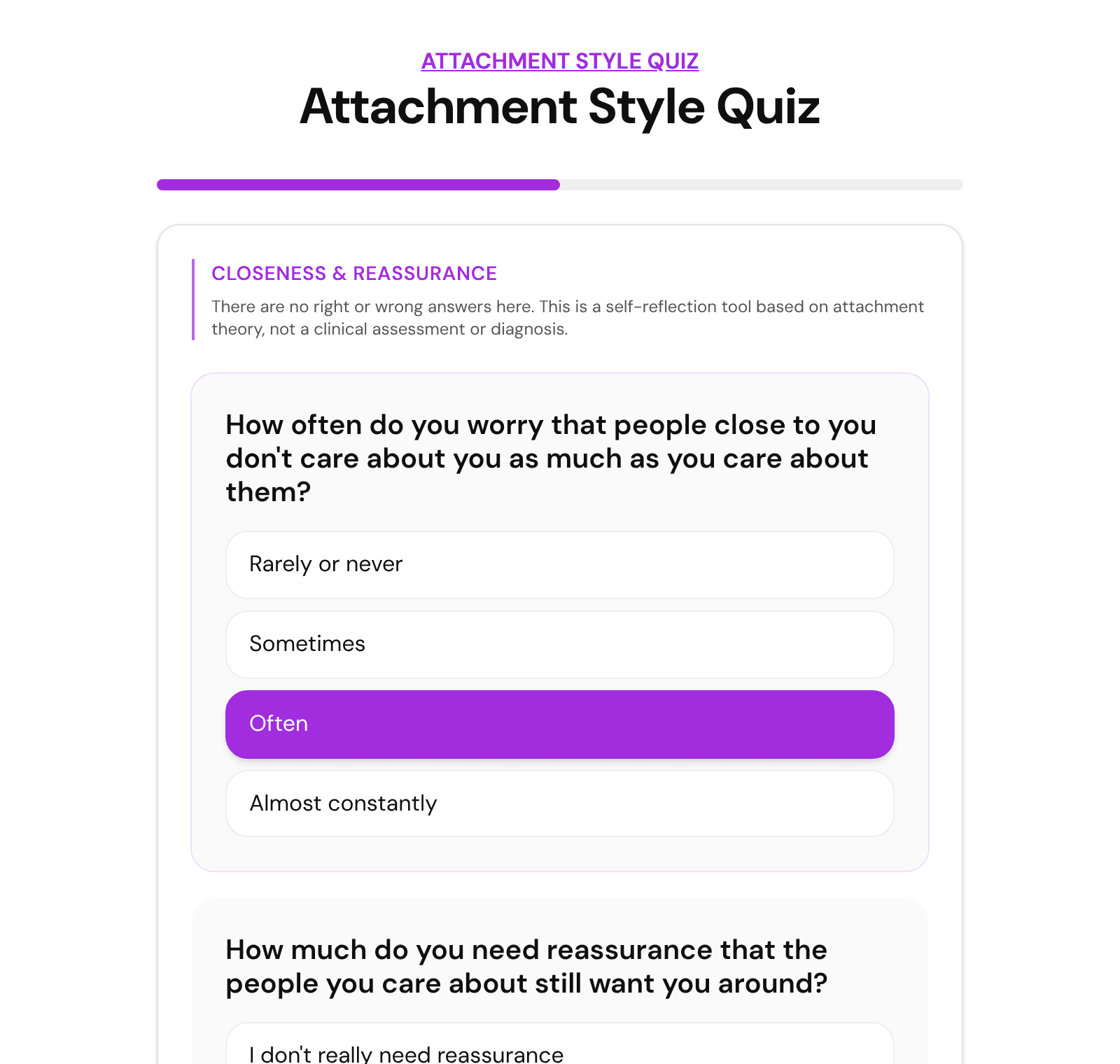
The quiz has 12 multiple-choice questions in two sections. The first six, Closeness and Reassurance, feed the Anxiety score. The second six, Independence and Distance, feed the Avoidance score. Every question has four answers worth 0, 5, 10 or 15 points, so each category runs from 0 to 90 points and is shown as 0 to 100 percent. Both categories use the same three tiers: Low from 0 to 39 percent, Moderate from 40 to 69 and High from 70 to 100. The outcome rules then compare the two percentages against 50 to pick Secure, Anxious, Avoidant or Fearful-Avoidant, with Mixed Pattern as the fallback. The result page shows both bars, the tiers and the outcome text together, so a person sees why they got the result, not just the name.
Why Build It in FluoTest?
FluoTest is a free scored quiz builder. You give each answer points in one or more score categories, so anxiety and avoidance are scored side by side in one quiz, each with its own tiers. Outcome rules compare the scores, for example anxiety percent greater than or equal to 50 and avoidance percent less than 50, instead of relying on one total, which is exactly what a two-dimension attachment quiz needs.
If you run it with clients or an audience, turn on the results email so each person keeps their scores, and sync respondents to Brevo with the scores as contact attributes. Webhooks to Zapier, Make or n8n are free. Slack, Google Sheets and email alerts for new submissions are on the Pro plan.
Try it: fluotest.com
How to Build Your Own Attachment Style Quiz in FluoTest
1. Start from the free attachment style template
Duplicate the template. It already has the 12 questions, the Anxiety and Avoidance categories with tiers, the four outcomes and the Mixed Pattern default, so you edit wording instead of rebuilding the logic.
2. Keep the disclaimer
The first section opens with a note that this is a self-reflection tool based on attachment theory, not a clinical assessment or diagnosis. Keep it, or write your own version. Attachment language is easy to over-read, and the note sets the right expectation before the first question.
3. Ask about behaviour, not labels
"When someone close to you seems distant or busy, what is your instinct?" gets an honest answer. "Are you anxiously attached?" does not. Keep each question tied to one dimension so the two scores stay clean.
4. Use graded answers
Give the four answers 0, 5, 10 and 15 points on the matching category. Graded answers let someone land at Moderate instead of being forced to the extremes, and the percentages stay readable.
5. Set the outcome rules
Create four outcomes that compare the two percentages against 50 and order them with the specific ones first. Make Mixed Pattern the default so nobody ends up without a result.
6. Write results people can act on
Each result in the template has a short description and a "what tends to help" paragraph. Add your own next step: a reflection exercise, a session booking link or a course module that matches the style.
7. Share, embed and follow up
Send the link, embed the quiz on your site or add it to a course. Turn on the results email, sync respondents to Brevo, or send each submission to your own tools with a webhook.
Who Is This Quiz For?
- -Anyone curious how they act in close relationships and wanting more than a one-word label
- -Relationship and life coaches who want a scored intake before the first session
- -Therapists building a self-reflection tool for new clients, with a clear not-a-diagnosis note
- -Course creators who teach communication, dating or relationship skills and want a lead magnet with a real result
- -Dating and wellbeing content creators who want a shareable quiz that ends in a next step
Frequently Asked Questions
What are the four attachment styles?
Secure, Anxious (also called anxious-preoccupied), Avoidant (dismissive-avoidant) and Fearful-Avoidant, also called Disorganized. They map to two scores: anxiety and avoidance. Secure is low on both, Anxious is high on anxiety, Avoidant is high on avoidance, and Fearful-Avoidant is high on both.
Is this attachment style quiz a diagnosis?
No. It is a self-reflection tool based on attachment theory, not a clinical assessment or diagnosis. If something in your result worries you, talk to a qualified therapist or counsellor.
How long does the attachment style quiz take?
About two minutes. It has 12 multiple-choice questions in two sections and shows both scores and your result instantly, with no account needed.
What does a Mixed Pattern result mean?
Mixed Pattern is the default result when your answers do not land clearly in one of the four combinations. Look at the two scores above the result: whichever is higher tells you which pattern to read more about. Attachment patterns can also vary from one relationship to another.
Can I use this quiz with my coaching clients or as a lead magnet?
Yes. Duplicate the template for free, add an email question, turn on the results email and link each result to a next step such as a booking link or a course module. Connect Brevo or a webhook to send each person's scores into your follow-up.
Ready to build your own scored quiz?
FluoTest is free. No credit card required. Start in 5 minutes.
What you get with FluoTest:
- - Several independent score categories in one quiz
- - Outcome rules that compare the scores, not just one total
- - Results emails for respondents and notifications for you
- - Brevo integration that syncs respondents with their scores
- - Webhooks for Zapier, Make and n8n
- - Per-question drop-off analytics
Questions? Read our pricing page or browse quiz templates.