Guide
Free Emotional Intelligence Test: Take the EQ Quiz and See Your Score
Most free EQ tests online give you one number and a generic label. That flattens the two things emotional intelligence is actually made of: how well you understand yourself, and how well you read and connect with other people. Someone can be highly self-aware and still struggle to empathize, or the other way around, and a single blended score hides which one it is. Below is a free 10-question emotional intelligence test that scores those two dimensions separately, plus how to build your own branded version if you coach, teach, or hire.
Quick answer
Where can I take a free emotional intelligence test?
FluoTest has a free 10-question EQ test that scores you on two dimensions, self-awareness and empathy & social skills, and gives you one of four personalized results instead of a single flat number. Take it below, no email or signup required, or duplicate the template to build your own branded version.
Take the Free EQ Test
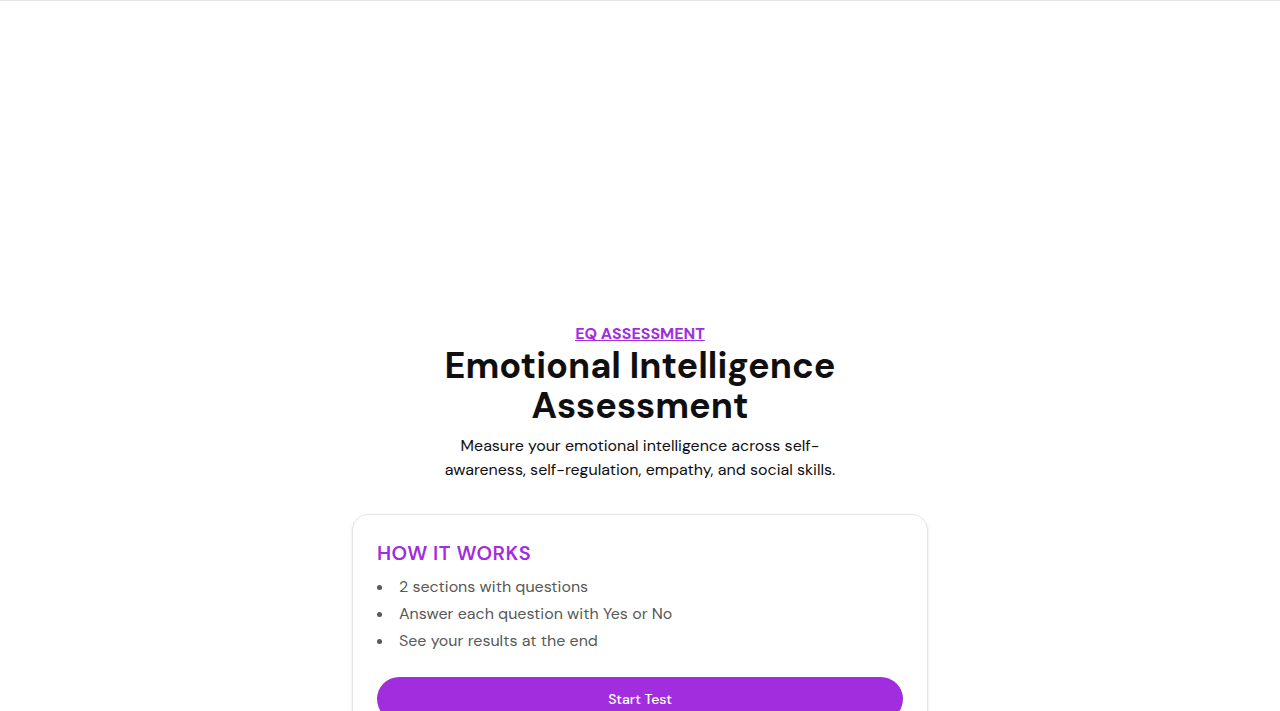
The full 10-question emotional intelligence test runs right here. Nothing is saved and no email is asked for; you see both scores and your profile at the end.
Prefer a full page, or want to copy the test for your own audience? Open the test as a template
What Is an Emotional Intelligence (EQ) Test?
An emotional intelligence test measures how well someone recognizes and manages their own emotions, and how well they read and respond to the emotions of others. It is built on the four-skill model popularized by psychologist Daniel Goleman: self-awareness, self-regulation, empathy, and social skills. Most free versions online compress all four into one overall score.
A scored version keeps self-awareness and empathy as two separate results instead of blending them into one number. Each answer carries a point value, the two totals map to their own tiers, Developing, Growing, or Strong, and the combination of both scores decides which of several result profiles you see, so two people with the same total score can get completely different, more accurate feedback.
Why Use FluoTest to Build It?
FluoTest is a free quiz builder built for scored assessments like this one. You assign point values to each answer, score multiple categories independently in the same quiz, self-awareness and empathy here, and set conditional outcomes that change the result copy based on how the categories combine, not just a single score range.
Every submission triggers an email with the full score breakdown, so if you are running this with a team, a coaching cohort, or a classroom, results land in your inbox the moment someone finishes. Connect Brevo to sync respondents with their EQ scores as contact attributes, or use webhooks for Zapier, Make, or n8n to route results into your own workflow.
Try it: fluotest.com
The 10 Questions in the EQ Self-Assessment Questionnaire
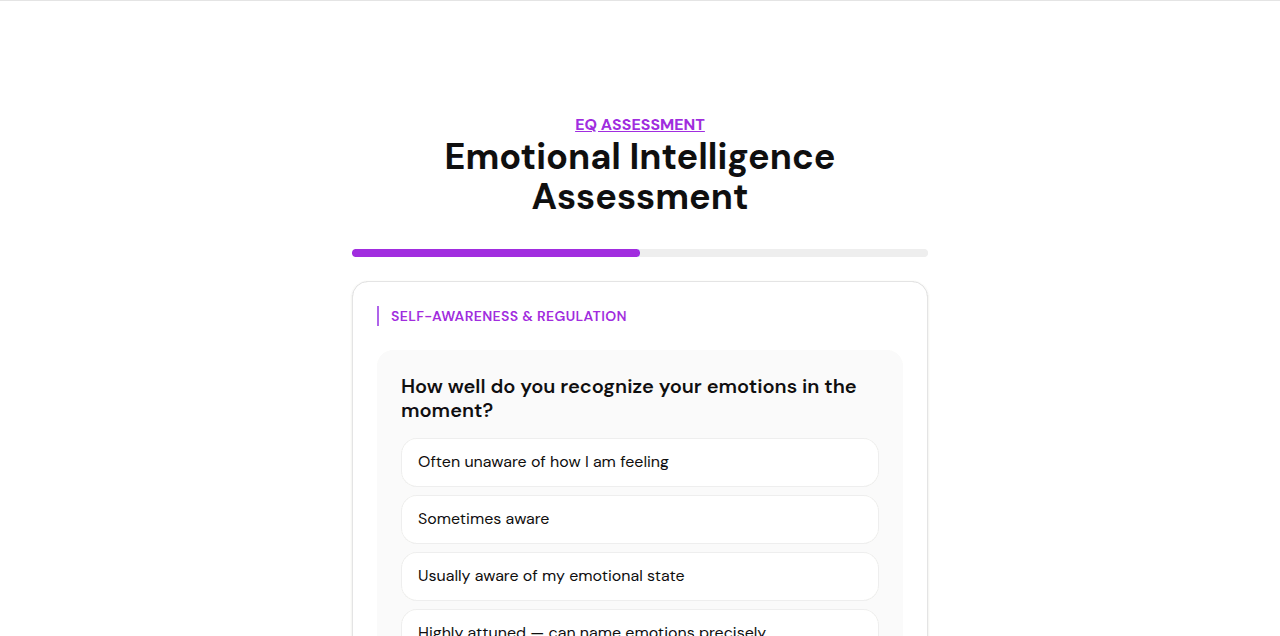
These are the ten questions in the free emotional intelligence questionnaire, in order, with the dimension each one scores. The first five score self-awareness and regulation, the last five score empathy and social skills, so you can see the shape of the test before you take it or copy it.
- 1. How well do you recognize your emotions in the moment?Self-awareness and regulation
- 2. How well do you manage difficult emotions under pressure?Self-awareness and regulation
- 3. How aware are you of how your mood and behavior affect others?Self-awareness and regulation
- 4. How do you typically respond when someone gives you critical feedback?Self-awareness and regulation
- 5. How well can you identify what triggers your strongest emotional reactions?Self-awareness and regulation
- 6. How well do you understand what others are feeling, even when they do not say it?Empathy and social skills
- 7. How effectively do you handle conflict and difficult conversations?Empathy and social skills
- 8. How well do you build rapport and trust with different types of people?Empathy and social skills
- 9. Which of these do people consistently say about you?Empathy and social skills
- 10. When a friend or colleague is visibly upset, what is your instinct?Empathy and social skills
Emotional Intelligence Test for Leaders and Managers
The same ten questions work as an emotional intelligence test for leaders: run it with a management team and compare the self-awareness and empathy profiles side by side, or use it as pre-work before a leadership workshop. If you want leadership-specific dimensions (communication, strategy, execution) rather than EQ, start from the leadership assessment template instead; the two combine well in one development programme.
Open the leadership assessment template · See all emotional intelligence and leadership templates
How to Build Your Own Emotional Intelligence Test in FluoTest
1. Start from the free EQ template
FluoTest has a ready-made Emotional Intelligence Assessment template with 10 questions already weighted and scored across self-awareness and empathy. Duplicate it and edit the wording instead of building the scoring logic from scratch.
2. Score self-awareness and empathy as separate categories
Keep them as two independent score categories, not one blended average. That is what lets you flag the specific gap, someone who knows themselves well but struggles to read others, or the reverse, instead of a single vague number.
3. Mix question types so it does not feel like a survey
The template uses weighted multiple choice for most questions, a slider for how well someone identifies their emotional triggers, and a multi-select for traits other people notice about them. Varying the format keeps a 10-question test from feeling repetitive.
4. Set three tiers per category
Developing (0 to 39 percent), Growing (40 to 69 percent), and Strong (70 to 100 percent) work well for both self-awareness and empathy. Keep the tier boundaries the same across both categories so the results stay easy to compare.
5. Write outcome profiles from the combination of both scores
Instead of one result per tier, write outcomes for the meaningful combinations: strong in both, strong self-awareness with empathy as the growth edge, strong empathy with self-awareness as the growth edge, and developing in both. Each profile should name the specific next step, not just repeat the score.
6. Publish and route the results
Share the link directly with a team, a client, or a class, embed it on your site, or send it as part of onboarding. Connect a webhook to push completed scores into a coaching CRM, HRIS, or Slack channel automatically.
Why a Two-Score EQ Test Beats a Single-Number Quiz
- -Separates self-awareness from empathy instead of blending them into one misleading average
- -Four outcome profiles give specific, actionable feedback instead of a generic label
- -Weighted scoring means the questions that matter most actually move the result
- -A slider and multi-select question break up the format so a 10-question test does not feel like a survey
- -Results arrive by email the moment someone submits, useful for coaches and managers reviewing a group at once
- -Fully free to duplicate, rebrand, and reuse for your own audience
Who Should Use This Test?
- -Anyone curious about their own EQ who wants more than a single generic score
- -Coaches and therapists who want a free intake tool that flags self-awareness or empathy as the growth edge
- -Managers building emotional intelligence into leadership development or 1:1 conversations
- -HR and L&D teams screening for EQ as part of a hiring or promotion process
- -Teachers and facilitators running an EQ exercise with a class or workshop group
Frequently Asked Questions
How accurate is a free online EQ test?
A free self-report test like this one is a useful signal, not a clinical diagnosis. It works best as a conversation starter, for self-reflection, or as an intake tool for coaching, not as the sole basis for a hiring decision.
Why does the test give two scores instead of one?
Self-awareness and empathy are different skills that do not always move together. Someone can understand their own emotions well and still struggle to read other people, or the reverse. Two scores show which one needs the most attention.
How many questions does the test have, and how long does it take?
10 questions split into two sections, Self-Awareness & Regulation and Empathy & Social Skills. It takes about 3 to 5 minutes.
Can I build my own version with different questions or branding?
Yes. The template is free to duplicate in FluoTest. Edit the questions, adjust the scoring weights, rewrite the four outcome profiles, and add your own branding, then publish it under your own link.
Is FluoTest free to use?
Yes. FluoTest is free forever with no submission limits, no quiz limits, and no credit card required.
Ready to build your own scored assessment?
FluoTest is free. No credit card required. Start in 5 minutes.
What you get with FluoTest:
- - Multiple independent score categories in a single quiz
- - Conditional outcomes based on how scores combine, not just one range
- - Email notifications with the full score breakdown on every submission
- - Brevo integration: auto-sync respondents with score attributes
- - Webhooks for Zapier, Make, and n8n
- - Per-question drop-off analytics
Questions? Read our pricing page or browse quiz templates.