Guide
Pre-Employment Assessment: How to Build a Skills Test That Predicts Performance
Years of experience is one of the weakest predictors of how someone will perform in a job. A short, well-built skills test is one of the strongest. This guide shows how to build a pre-employment assessment that tests what the job actually needs: which question types to use, a question bank for four common roles, how to weight and tier the scores, where knockout questions belong, and how to keep it fair and GDPR-compliant. There is a free template at the end that you can copy and edit.
Quick answer
How do you create a pre-employment assessment?
List the three to five skills the role needs in its first 90 days. Test each one with job knowledge questions, situational judgment questions and a short work sample, not with self-ratings. Give every answer points, weight the skills that matter most, and set three tiers: advance, human review, and below the bar. Put any legal must-haves first as knockout questions, give every candidate the same test, and have a person confirm every rejection. FluoTest has a free pre-employment skills assessment template that does the scoring and routing for you.
Open the free pre-employment assessment template
What Is a Pre-Employment Assessment?
A pre-employment assessment is a structured test candidates take before an interview or an offer. Instead of asking people to describe their skills, it asks them to use those skills: answer a job knowledge question, choose how to handle a realistic situation, or complete a small piece of the actual work. Every candidate gets the same questions and the same scoring, so you compare people on evidence instead of on how well they write a CV.
It is not the same as a screening questionnaire. Screening checks the basics, like work authorization, availability and salary range, and filters the applicant pile. The assessment comes next and answers the harder question: can this person do the job well? If you want to automate the screening step too, see our guide to scored hiring quizzes linked below.
Screening applicants before the assessment? Read the companion guide on scored screening quizzes
Why Skills Tests Beat CVs
The best-known research on this question is a 2022 meta-analysis by Sackett, Zhang, Berry and Lievens in the Journal of Applied Psychology, which re-estimated how well common selection methods predict job performance. Structured interviews came out on top, followed closely by job knowledge tests and work sample tests. Situational judgment tests also predicted performance. Years of job experience predicted almost nothing.
The takeaway is practical: test the job, not the résumé. A 10 to 15 minute assessment built from job knowledge, judgment and work-sample questions gives you a better signal than an hour of reading CVs, and then your structured interview goes deeper with the candidates who earned it.
The Four Question Types to Use
A good assessment mixes question types, because each one measures something different. The free template uses all four.
Knockout questions
Yes or no questions for requirements that are truly non-negotiable, such as legal authorization to work or a required license. A wrong answer ends the assessment politely. Use them sparingly: one or two at most.
Job knowledge
Multiple-choice questions with a correct or best answer, about things the person must know on day one. Examples: what a metric means, which ticket is urgent, which formula a spreadsheet needs.
Situational judgment
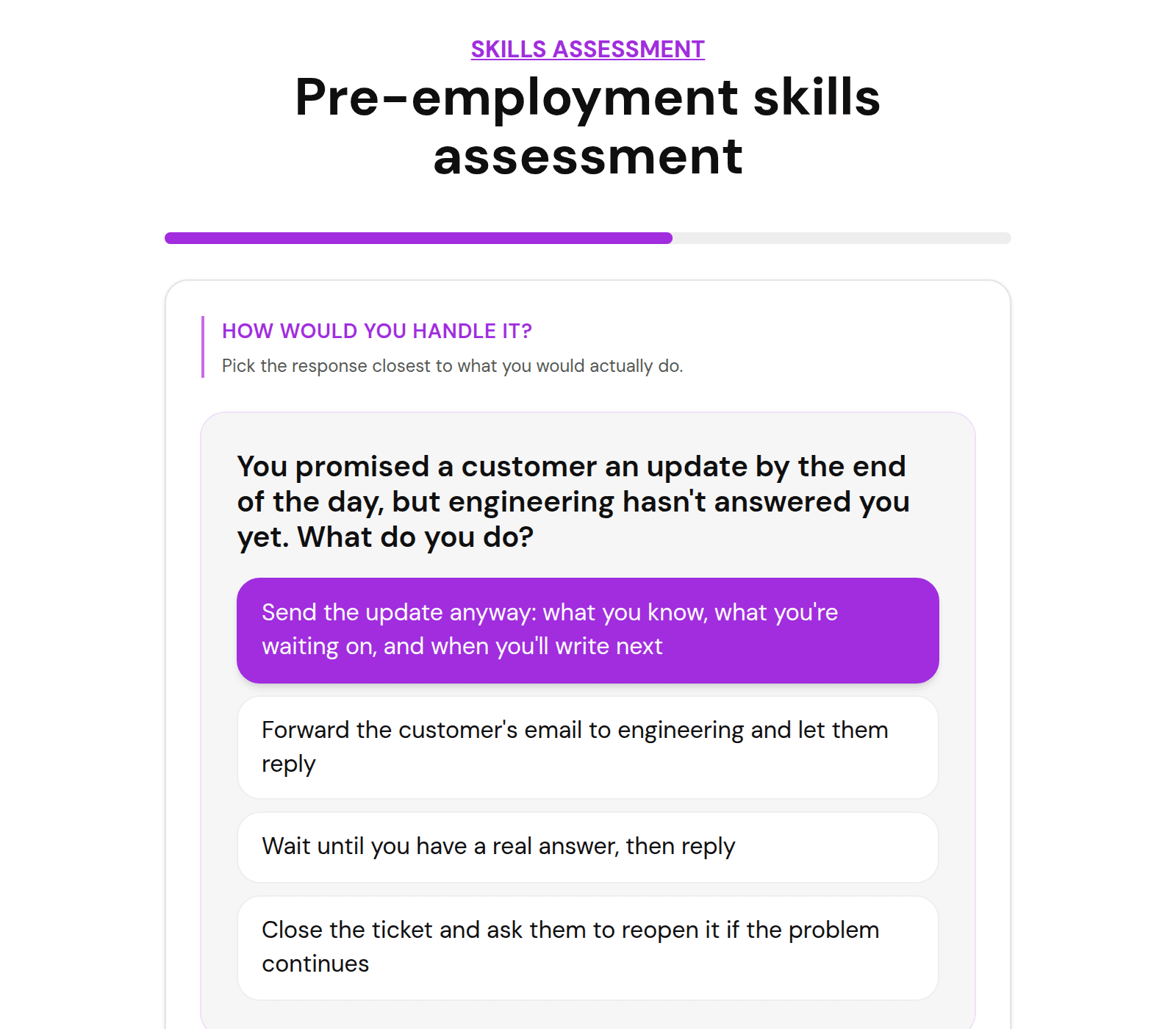
A realistic scenario with four possible responses, scored from best to worst. It shows how someone thinks about trade-offs like speed versus quality, or policy versus the customer in front of them.
Work sample
A small, real piece of the job: pick the best reply to an email, spot the error in a draft, or write two sentences a customer will read. Score the multiple-choice parts automatically and read the open answers yourself.
Pre-Employment Test Questions by Role
Here are example questions for four common roles. Each role has one job knowledge question, one situational judgment question and one work sample. Replace the details with your own tools, policies and customers.
Customer support
- -Job knowledge: What does "first response time" measure? (Best answer: the time from the customer's message to the first human reply.)
- -Situational judgment: You promised an update today, but engineering hasn't replied. What do you do? (Best answer: update the customer anyway with what you know and when you'll write next.)
- -Work sample: Pick the best reply to "Your app deleted my project." (Best answer acknowledges the loss, takes an action and gives a time.)
Sales (SDR or account executive)
- -Job knowledge: A prospect has budget and need but no decision-maker on the call. Which stage is this deal in, using your sales process?
- -Situational judgment: A prospect asks for a 30% discount on the first call. What do you do? (Best answer: ask what is driving the request and anchor on value before any discount.)
- -Work sample: Which of these three cold email openers is most likely to get a reply from a busy operations manager, and why?
Operations or office admin
- -Job knowledge: Which spreadsheet function finds a value in one table and returns a matching value from another? (Answer: XLOOKUP or VLOOKUP.)
- -Situational judgment: Two managers ask you for urgent work due at the same time. What do you do first? (Best answer: tell both, ask who sets the priority, and agree on new deadlines.)
- -Work sample: Here is a supplier invoice with one error. Which line is wrong?
Marketing
- -Job knowledge: A landing page had 2,000 visits and 60 sign-ups. What is its conversion rate? (Answer: 3%.)
- -Situational judgment: A campaign is performing well but the sales team says the leads are poor. What do you check first? (Best answer: lead quality by source and the handoff criteria, not only volume.)
- -Work sample: Pick the strongest of four subject lines for a product launch email to existing customers.
How to Weight the Questions and Set Pass Tiers
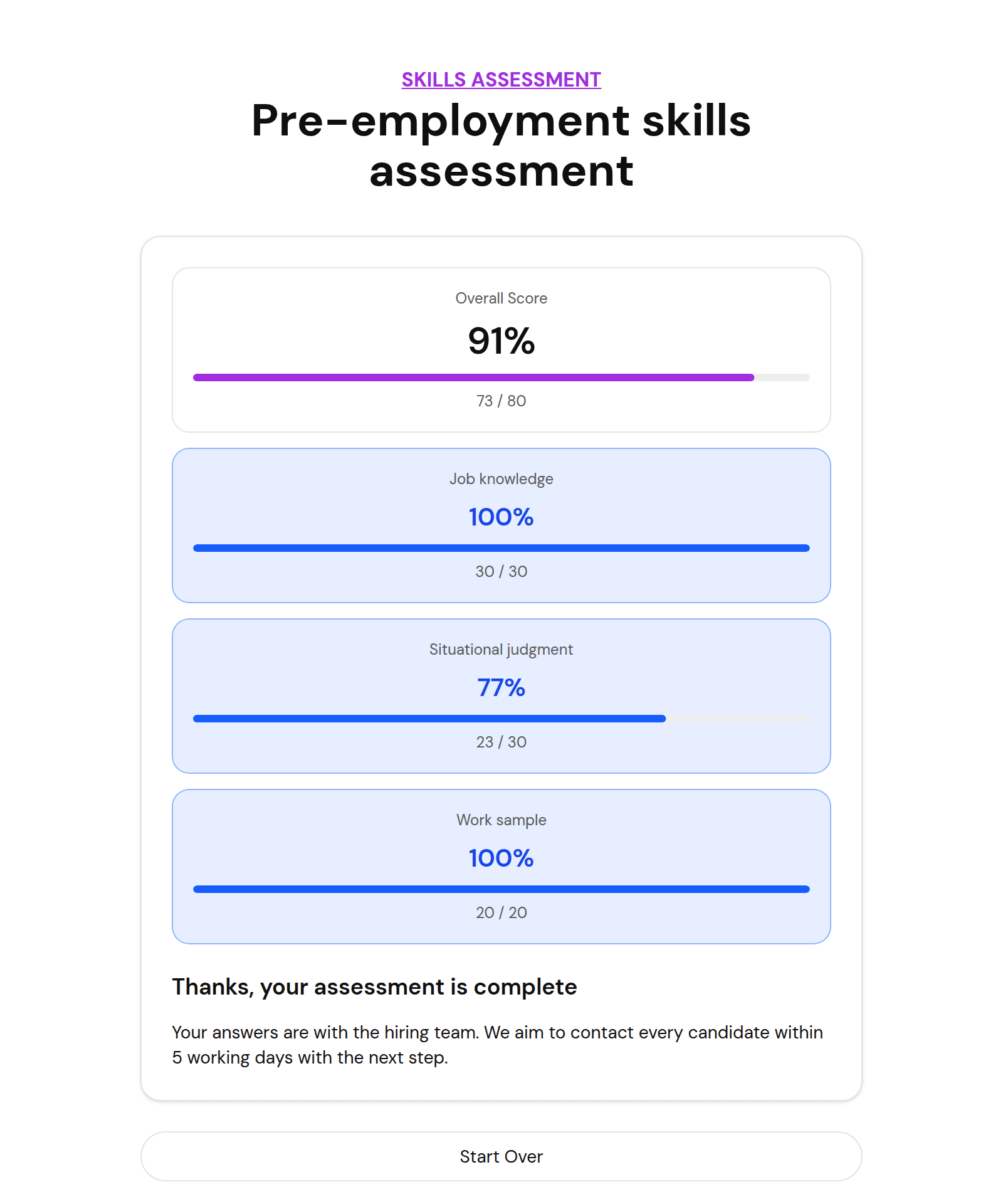
Give every answer points, not just the correct one. In a situational judgment question, the best response might earn 10 points, a reasonable one 5, a weak one 2 and a harmful one 0. Partial credit tells you far more than right or wrong. Then weight the skills: if judgment matters more than product knowledge for this role, give that category more questions or higher point values, so it counts for more of the total.
Set three tiers based on the percentage score, not a single pass mark. Start with the thresholds below, then adjust them after your first 20 or so candidates, once you can compare scores with what you saw in interviews.
75% and above: Advance
Invite to a structured interview. These candidates showed the skills; the interview checks depth and motivation.
50 to 74%: Human review
A recruiter reads the answers, especially the open work-sample question, and decides. Many good hires sit here.
Below 50%: Below the bar
Probably not a fit for this role right now. A person still confirms before anyone is declined.
Where Knockout Questions Belong
Put knockout questions at the very start, so nobody spends ten minutes on a test for a role they legally can't take. Keep them to hard requirements you would enforce for every single candidate: work authorization, a required certification, or a license the job depends on. "Five years of experience" is not a knockout; it is a preference, and it filters out people who could do the job.
In FluoTest, mark the question as a disqualifier and choose the answer that disqualifies. The candidate sees a polite, specific message, and the submission is labeled so your team knows why it ended.
Keep It Fair, Accessible and GDPR-Compliant
A skills test can reduce bias, because everyone is judged on the same evidence. It can also add bias if it tests the wrong things. Follow these rules:
- -Test only what the job needs. Every question should map to a skill in the job description. If you can't explain why a question predicts performance in this role, remove it.
- -Give every candidate the same test, the same time and the same scoring. Randomizing answer order is fine; changing the questions per person is not.
- -Don't ask about health, religion, ethnicity, sexual orientation, political views or union membership. These are special-category data under GDPR and have no place in a skills test.
- -Tell candidates how their results are used before they start: what is scored, who sees it, how long you keep it, and who to contact. GDPR requires this transparency.
- -Keep a human in the loop. Under GDPR Article 22, people have the right not to be subject to decisions based solely on automated processing when those decisions significantly affect them. Let the score sort candidates; let a person make the decision.
- -Make it accessible. Keep it short, allow extra time on request, and don't use a time limit unless speed is part of the job.
- -Check your results. Once you have enough candidates, compare pass rates across groups. In the US, a group passing at under four-fifths of the rate of the highest group is a common red flag for adverse impact.
Why Build Your Assessment in FluoTest?
FluoTest is a free quiz builder for scored assessments. You give each answer points in one or more categories, score job knowledge, judgment and work sample side by side, mark knockout questions as disqualifiers, and route each candidate to an outcome based on their score. You can hide the score from candidates, so they see a neutral thank-you message while your team sees the full breakdown.
Every submission can email your hiring team the score, the tier and every answer, including the open work-sample responses. Randomize answer order, add an optional time limit, and send results to your ATS or a spreadsheet with a webhook to Zapier, Make or n8n.
Try it: fluotest.com
See our pricing page · Open the free pre-employment assessment template
How to Build a Pre-Employment Assessment in 6 Steps
1. List the skills the job needs in its first 90 days
Talk to the hiring manager and pick three to five skills that separate a strong performer from a weak one. For a support role: product knowledge, prioritization, written tone. These become your score categories.
2. Start from the free template
Copy the FluoTest pre-employment skills assessment template. It already has a knockout question, three score categories (job knowledge, situational judgment, work sample), an open work-sample task and four outcomes, so you only rewrite the questions for your role.
3. Write two or three questions per skill
Use the question bank above as a starting point. Base scenarios on real tickets, deals or tasks from the last few months. Keep the whole test to 10 to 15 minutes: long tests lose your best candidates first, because they have other options.
4. Score every answer and set the tiers
Give partial credit for reasonable answers, weight the skills that matter most, and set advance, review and below-the-bar thresholds. Ask two colleagues to take the test first: if a strong teammate scores below 75%, the test is too hard or the answer key is wrong.
5. Add the candidate notice and hide the score
In the welcome text, explain what is being tested, how long it takes, how results are used and who to contact. Turn on "Hide score from respondents" so candidates see a neutral message, and write the same next-step message for every tier.
6. Route the result to a person
Send each submission to the hiring team by email or to your ATS with a webhook. Advance the top tier to a structured interview, review the middle tier by hand, and have a person confirm every decline. Review the thresholds after each hiring round.
Who Should Use a Pre-Employment Assessment?
- -HR teams hiring for roles with many applicants, such as support, sales and operations
- -Recruitment agencies that want to send clients shortlists backed by evidence, not only CVs
- -Small businesses without an HR department that want a consistent way to compare candidates
- -Hiring managers who want the interview to go deeper instead of re-checking the basics
- -Teams hiring remotely across countries, where CVs and qualifications are hard to compare
Frequently Asked Questions
What is a pre-employment assessment test?
It is a structured test candidates take before an interview or an offer, measuring the skills the job needs through job knowledge questions, situational judgment scenarios and short work samples. Every candidate gets the same test and the same scoring.
How long should a pre-employment assessment be?
Aim for 10 to 15 minutes and 8 to 15 questions. Longer tests increase drop-off, and the strongest candidates, who have other offers, tend to leave first. Save longer work samples for the final round.
What is a good passing score on a pre-employment test?
There is no universal pass mark. A good starting point is 75% to advance, 50 to 74% for human review and below 50% as below the bar, then adjust after comparing scores with interview results from your first 20 or so candidates.
Are pre-employment tests legal?
Yes, when they are job-related and applied consistently. Test only skills the job needs, give everyone the same test, avoid special-category data such as health or religion, tell candidates how results are used, and keep a person involved in rejection decisions. For specific legal questions, check with an employment lawyer in your country.
Should candidates see their score?
Usually not. Showing a number invites disputes about single questions and can discourage people who are still worth a review. Show a neutral thank-you with a clear timeline, and share feedback personally when you decline someone.
Is FluoTest free for hiring assessments?
Yes. FluoTest is free, including point-based scoring, score categories, disqualifier questions, outcomes and email notifications. No credit card is required. Usage is subject to our fair-use policy.
Build your pre-employment assessment today
FluoTest is free. No credit card required. Start from the template in 5 minutes.
What you get with FluoTest:
- - Points per answer, with partial credit
- - Separate scores for job knowledge, judgment and work sample
- - Knockout questions with a polite, specific message
- - Hidden scores for candidates, full breakdowns for your team
- - Email notifications with every answer
- - Webhooks for Zapier, Make and n8n
Questions? Read our pricing page or browse quiz templates.