Guide
How to Build a Digital Transformation Readiness Assessment (Free Template)
Most digital transformation readiness checklists give you one score and stop there. That is not enough to act on: a leadership team can be fully bought in while the technology stack is years behind, or the tech can be ready while the organization is not prepared to change how it works. A scored readiness assessment measures leadership, technology, and culture separately, then uses conditional logic to tell you exactly which one is holding the transformation back. Here is how to build one.
Quick answer
How do you build a digital transformation readiness assessment?
Score three dimensions, leadership commitment, technology maturity, and culture and change readiness, with weighted questions, then use conditional result rules to flag which dimension is the real bottleneck instead of one vague readiness score. FluoTest has a free ready-made template you can publish in minutes.
What Is a Digital Transformation Readiness Assessment?
A digital transformation readiness assessment measures how prepared an organization is to execute a digital transformation initiative, typically across leadership sponsorship, technology infrastructure, and organizational culture. It goes beyond a generic maturity checklist by scoring each dimension independently.
A scored version adds the layer that makes it actionable: instead of one average number, conditional rules compare the three category scores against each other and surface the specific bottleneck, technology, culture, or leadership, so you know exactly where to focus before launching the initiative.
Why Use FluoTest to Build It?
FluoTest is a free quiz builder built for scored assessments. You assign weighted point values to each answer across multiple score categories, and use conditional logic to compare categories against each other, not just against a single overall threshold, so you can surface combinations like "leadership and culture are ready but technology is the bottleneck."
Every submission triggers an email with the full score breakdown per category, so you or your client see the result the moment it comes in. You can also connect Brevo to sync respondents with their readiness scores, use webhooks for Zapier, Make, or n8n to route results into your CRM or Slack, and see per-question drop-off analytics to spot where stakeholders stall out.
Try it: fluotest.com
How to Build a Digital Transformation Readiness Assessment in 6 Steps
1. Start from the ready-made template
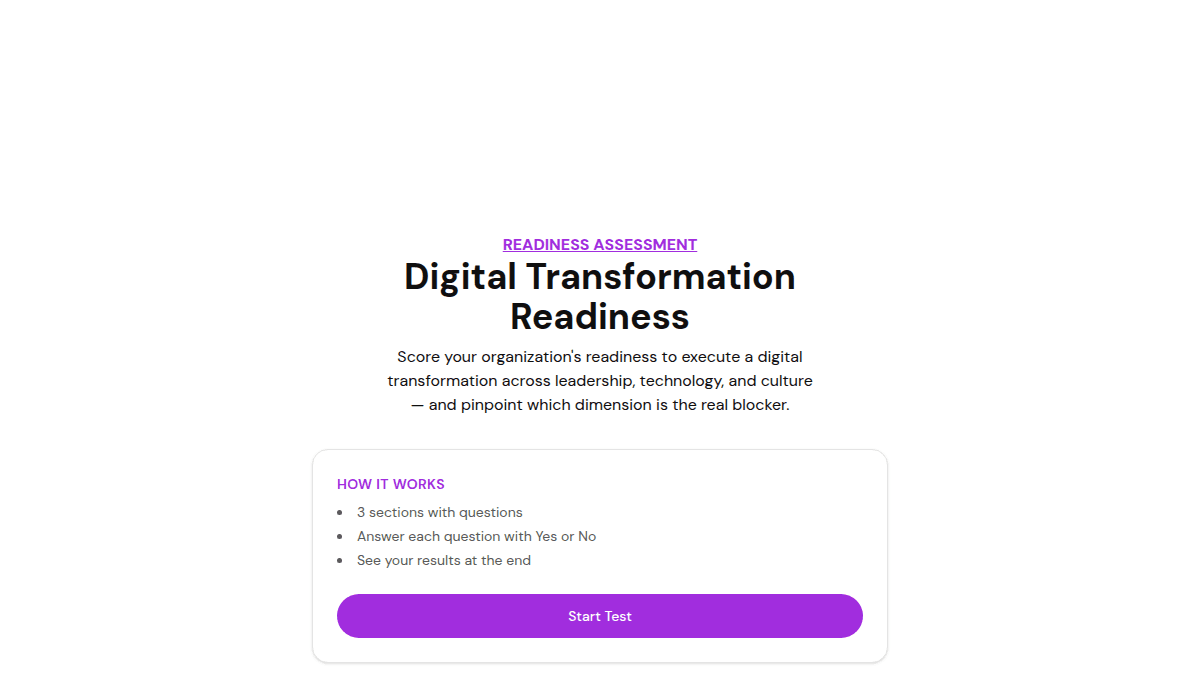
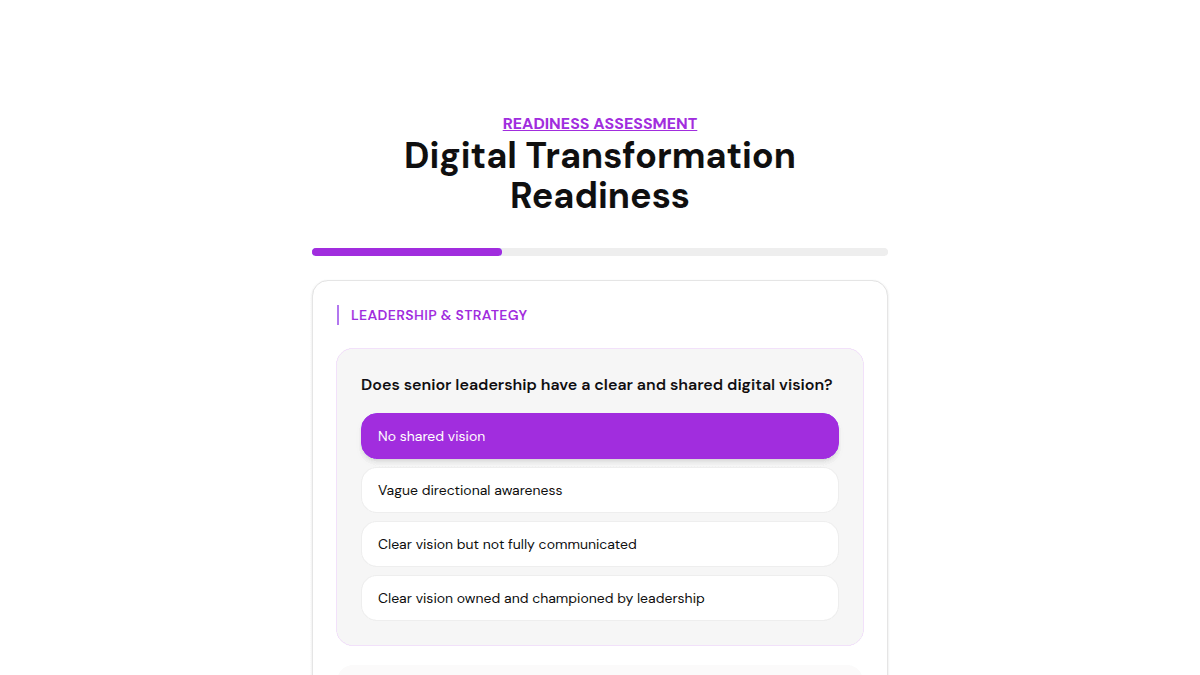
FluoTest has a free Digital Transformation Readiness template with leadership, technology, and culture questions, weighted scoring, and bottleneck logic already built in. Duplicate it and adjust the wording to your organization or your client's instead of starting from a blank quiz.
2. Define your three scoring categories
Leadership & Vision (sponsorship, budget, a shared strategic vision), Technology & Data (infrastructure maturity, data management, integration capability), and Culture & Change Readiness (workforce openness to change, internal skills, track record with past initiatives).
3. Write weighted questions per category
Mix multiple-choice questions with graduated point values, a multi-select for checking off existing capabilities, a yes/no for whether success metrics are defined, and an open question asking respondents to name the biggest risk in their own words.
4. Set conditional outcomes that compare categories
Instead of one overall score, write rules that compare categories to each other: leadership and culture above 55% but technology below 40% means technology is the bottleneck, and so on. This is what turns three numbers into a specific, actionable finding.
5. Write result copy for each bottleneck
For each outcome, name the constraint plainly and recommend the next step: a technology modernization sprint, a change-management workshop, or a broader readiness-building phase if all three dimensions are weak.
6. Publish and share with stakeholders
Send the assessment to leadership, IT, and operations separately, or run it once with a respondent and department field. Connect a webhook to route results into Slack or your CRM, and use the score breakdown to open the transformation kickoff conversation with data instead of opinions.
Try it:
Build your assessment freeWhy a Scored Readiness Assessment Works Better Than a Generic Checklist
- -Points to the specific bottleneck, leadership, technology, or culture, instead of one vague readiness percentage
- -Weighted scoring reflects that some factors, like executive sponsorship, matter more than others
- -Conditional logic compares categories against each other, not just against a flat threshold
- -Results arrive by email the moment someone submits, with the full category breakdown attached
- -Drop-off analytics show which section respondents abandon, useful when a busy executive doesn't finish
- -Consultants and agencies can rebrand the assessment and reuse it across multiple clients
- -Webhooks push results straight into Slack or a CRM so findings reach the right team immediately
Who Should Build a Digital Transformation Readiness Assessment?
- -Consultants and agencies running readiness diagnostics before proposing a transformation engagement
- -IT and operations leaders who want a structured self-assessment before requesting budget
- -PMOs scoping a transformation initiative and needing to justify where to invest first
- -Digital transformation vendors qualifying prospects before a discovery call
- -Executive teams evaluating whether the organization is actually ready to fund a major initiative
Frequently Asked Questions
What is the difference between a readiness assessment and a maturity model?
A maturity model typically places an organization on a fixed stage scale. A scored readiness assessment measures specific dimensions, like leadership, technology, and culture, independently and uses conditional logic to identify which one is actually blocking progress right now.
How many questions should the assessment have?
Eight to twelve works well: two to four per category. Enough to weight the score meaningfully without making a busy executive abandon it halfway through.
What should happen when technology scores low but leadership scores high?
Flag it as a technology bottleneck and recommend a modernization sprint before scaling the broader initiative. FluoTest's conditional logic lets you write that exact rule, comparing category scores against each other rather than relying on one overall number.
Can I rebrand this for my consulting clients?
Yes. Duplicate the free template, swap in your own logo, colors, and question wording, and reuse it across every client engagement. Each client gets their own scored result and you get a structured, repeatable diagnostic.
Is FluoTest free to use for this?
Yes. FluoTest is free forever with no submission limits, no quiz limits, and no credit card required.
Ready to build your readiness assessment?
FluoTest is free. No credit card required. Start in 5 minutes.
What you get with FluoTest:
- - Weighted scoring across multiple categories
- - Conditional logic that compares categories against each other
- - Email notifications with the full score breakdown on every submission
- - Brevo integration: auto-sync respondents with score attributes
- - Webhooks for Zapier, Make, and n8n
- - Meta Pixel & GTM for conversion tracking
- - Per-question drop-off analytics
Questions? Read our pricing page or browse quiz templates.