Guide
Founder Assessment: What to Measure, How to Score It, and 3 Free Templates
Every accelerator, startup coach and angel investor assesses founders. Most of them do it in their head, in a 30-minute call, with a different set of questions for each person. A founder assessment turns that gut feel into a scored, repeatable tool: the same questions for everyone, points per answer, a profile per dimension and a next step that follows from the score. This guide covers what a good founder assessment measures, how to score it, the mistakes that make results useless, and three free templates you can copy today.
Quick answer
What is a founder assessment?
A founder assessment is a scored questionnaire that profiles a founder across the dimensions that matter for building a company, typically vision and strategy, execution, people and leadership, selling, resilience, and market or traction. Each answer earns points in one or more dimensions, so the result is a profile rather than a single grade, and the profile drives a decision: who gets into the cohort, which coaching track fits, which co-founder or first hire fills the gap, or whether a startup is ready to raise. You can build one for free in FluoTest; start from the Founder Strengths Assessment template.
Open the free Founder Strengths Assessment template
What Is a Founder Assessment?
A founder assessment is a structured questionnaire that scores a founder, or a founding team, on the skills and habits that predict whether they can build the company they are pitching. The founder answers the same questions as everyone else, every answer earns points in one or more dimensions, and the result is a profile: strong here, developing there, a clear gap over there. That profile is what makes the assessment useful. A single overall score hides exactly the information you need.
It is not a personality test and it is not a pitch review. A pitch tells you about the idea. A founder assessment tells you about the person who has to execute the idea, usually through a mix of self-rated statements, habit questions (what the founder actually did last week), a few numbers (years managing people, hours spent building, months of runway) and one or two open questions that a human reads before the decision.
Who Uses Founder Assessments, and for What Decision
The same assessment serves different decisions. Being clear about which decision you are scoring for changes which dimensions get the most weight.
Accelerator and incubator applications
Hundreds of applications, a handful of places. A scored assessment at the application stage ranks founders on the same evidence before the partners spend an hour on each interview, and the open answers give interviewers something concrete to probe.
Startup coaching and mentoring fit
A coach uses the profile to decide which track or mentor fits: a visionary founder with weak execution needs a different programme than an operator who cannot tell the story. The same quiz run again after six months shows what the coaching changed.
Co-founder and first-hire gap analysis
Both co-founders take the assessment. Two visionaries and no operator is a known failure mode, and seeing it on a chart before the company is incorporated is cheaper than discovering it at month nine.
Investor and angel group pre-screening
Angel syndicates and pre-seed funds add a short investment readiness check to their deal intake: team, market, traction. Startups below the bar get a polite, specific no with the reasons; the ones above it get a meeting.
Cohort pre-work and progress tracking
Run the assessment at kick-off and again at demo day. Per-dimension scores give the programme a before-and-after that a feedback survey never will, and give each founder a personal development plan on day one.
The 6 Dimensions Worth Scoring
Most founder assessments converge on the same handful of dimensions. For each one, the card lists what to ask and how to score it so the answer is harder to inflate.
1. Vision and strategy
What to ask: Comfort with long-term strategy, how often the founder reviews new opportunities or pivots, whether they block time for strategic thinking, how clearly they can explain why this market and why now.
How to score it: Pair one self-rating with one habit question. 'I systematically review options on a regular cadence' is worth more than 'visionary thinking is my superpower', because it describes a behaviour, not an opinion.
2. Execution and operations
What to ask: How reliably plans turn into shipped outcomes, how the founder handles ambiguity, whether they review metrics weekly, what they shipped in the last 30 days.
How to score it: Give the most points to specific recent evidence. A number question such as 'how many releases, deals or experiments did you ship last month' with scored ranges is harder to game than a 1 to 5 confidence rating.
3. People and leadership
What to ask: Years of people-management experience, whether they hold regular 1:1s, how they describe hiring and losing people, whether they can attract talent they cannot yet afford.
How to score it: Use a number question with ranges for experience (0 to 1, 1 to 3, 3 to 6, 6 or more years) and a multi-select for the habits. Both feed the same dimension.
4. Selling and storytelling
What to ask: How effective the founder is at persuading investors, customers and candidates, and how much they enjoy pitching. Selling is the one skill a founder cannot delegate in the first two years.
How to score it: Let this question contribute to two dimensions at once, for example vision and people, because selling draws on both. Multi-category scoring is exactly what a founder assessment needs.
5. Resilience and self-management
What to ask: How the founder manages energy, focus and wellbeing, how they respond when something goes wrong, whether the current pace is sustainable.
How to score it: Score the sustainable answers highest and treat 'burning out' as a flag for a human conversation, not as a reason to decline. This dimension predicts whether the founder is still there in year three.
6. Market and traction (for investment readiness)
What to ask: Size and clarity of the market, evidence of demand, revenue or usage to date, months of runway, what has already been validated with paying customers.
How to score it: Keep this in a separate score category from the founder's personal dimensions. A strong team with no traction and a strong product with a weak team need different conversations, and one combined score cannot tell them apart.
3 Free Founder Assessment Templates
All three are free FluoTest templates with questions, scoring and outcomes already configured. Open the preview, take it yourself, then copy it and change the wording to match your programme.
Founder Strengths Assessment
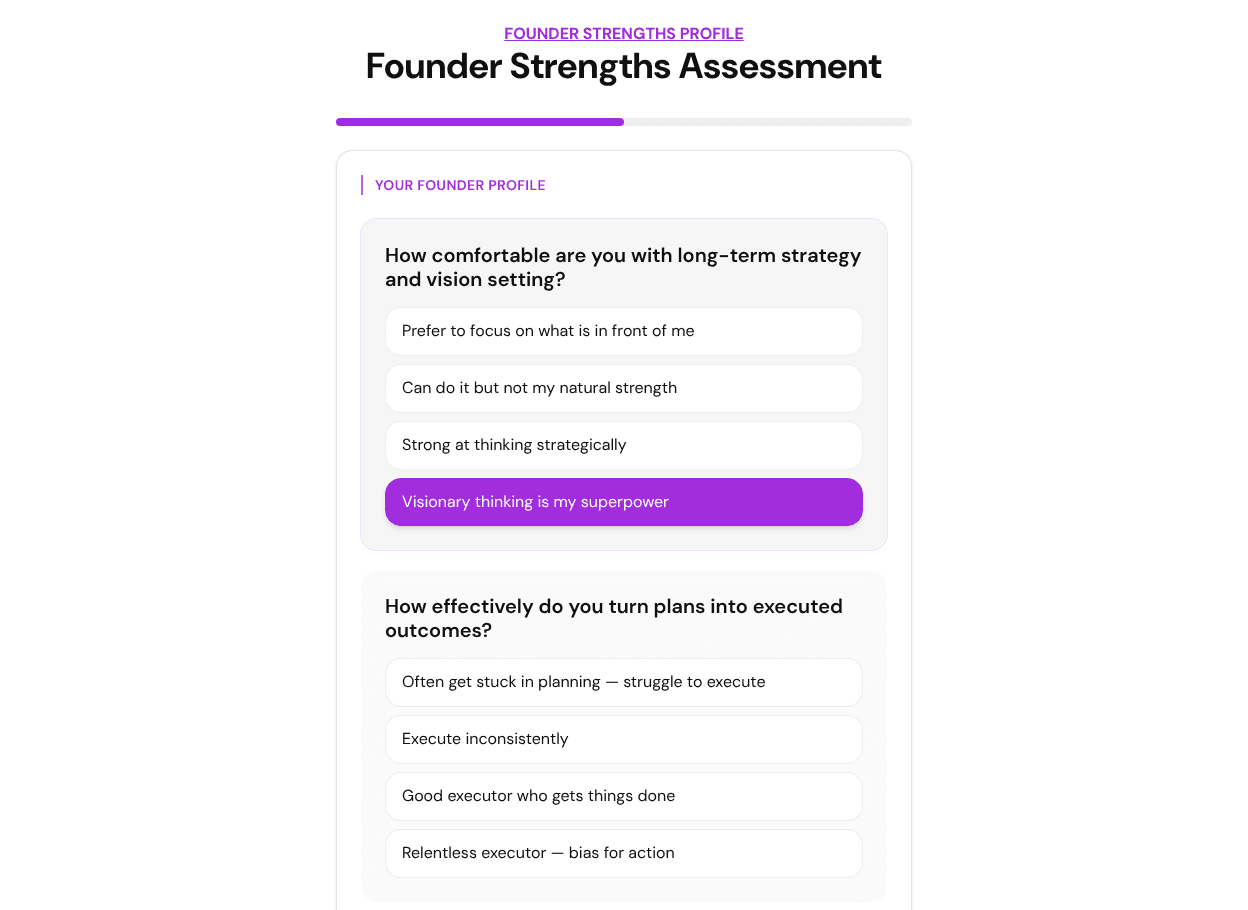
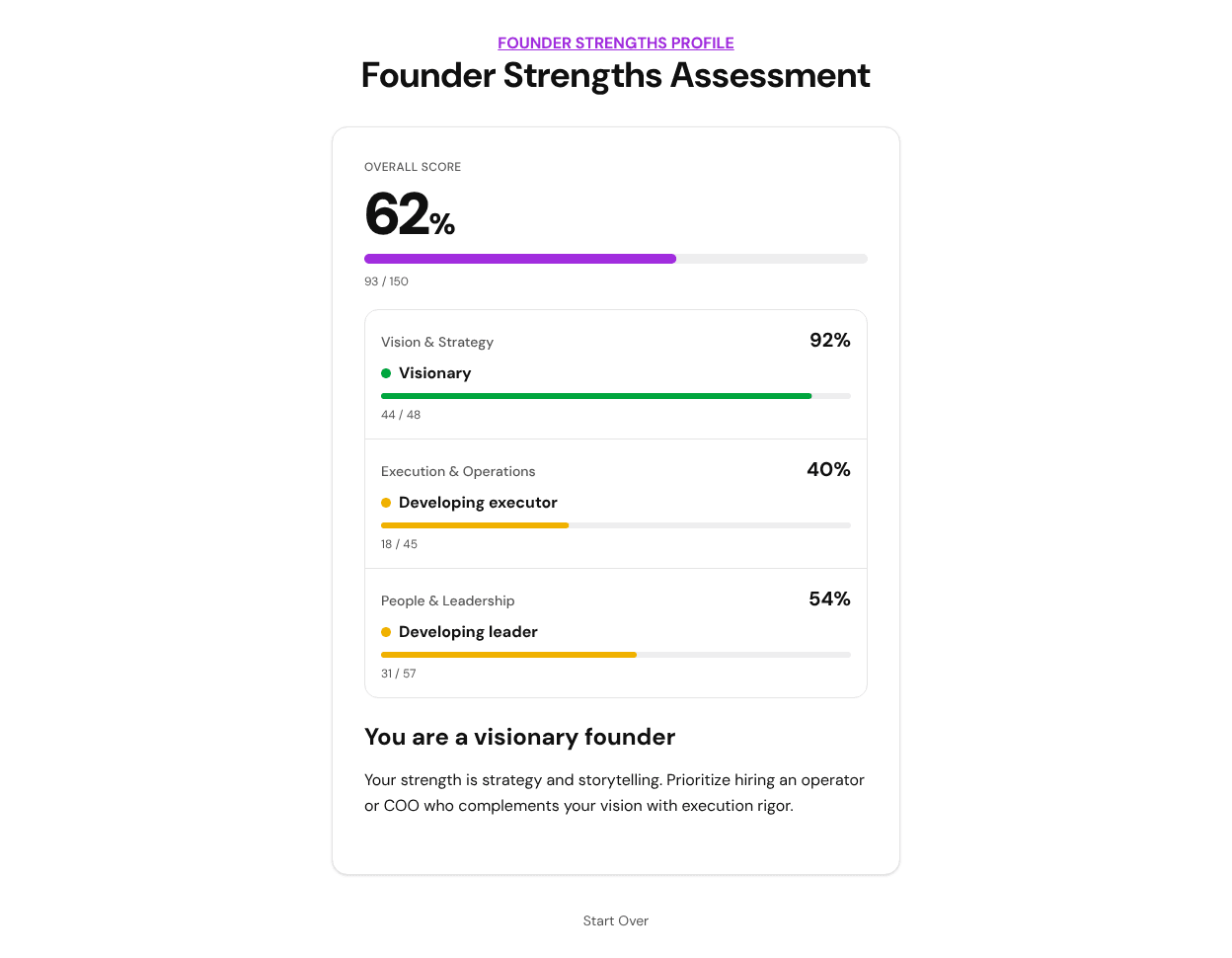
Ten questions across two sections that score Vision and Strategy, Execution and Operations, and People and Leadership separately. Four outcomes: visionary founder, execution-first founder, people-first founder and well-rounded founder, each with a hiring recommendation. The template shown in the screenshots below.
Best for: Accelerator intake, coaching fit, co-founder gap analysis.
What kind of entrepreneur are you?
A shareable nine-question quiz that profiles founders as Visionary, Operator or Maker, with a personalised takeaway per type. Lighter and more fun than the strengths assessment, which makes it a good lead magnet for a coaching practice or a community.
Best for: Startup coaches, founder communities, newsletter growth.
Startup Investment Readiness
Ten questions in three sections, Founding Team, Market and Product, and Traction and Revenue, with a separate score per section. Four outcomes from investment-ready to pre-investment stage, each explaining what to fix before fundraising.
Best for: Angel groups, pre-seed funds, accelerator demo-day preparation.
4 Mistakes That Make a Founder Assessment Useless
- -One overall score. 'Founder: 62%' tells you nothing. Separate score categories per dimension are the whole point; the overall number is at best a tiebreaker.
- -Only self-ratings. Founders are optimists by selection. Mix in habit questions (what they actually did last week), numbers with scored ranges, and one open question a human reads.
- -Pass or fail on personality. Founder type is descriptive, not a filter. Use it to match mentors and plan hires, and base any decline on evidence such as traction, runway or domain experience.
- -No next step. A score nobody acts on is a survey. Decide in advance what happens at each tier: interview, waitlist, a specific coaching track, a polite no with reasons.
Why Build Your Founder Assessment in FluoTest?
FluoTest is a free quiz builder for scored assessments, and multi-dimension scoring is built in. Every answer earns points in one or more categories, so one quiz produces separate Vision, Execution and People scores with their own tiers and colours. Outcomes combine those scores with conditions (Vision 70% or more and Execution under 60% means visionary founder) and each outcome can show different result copy, redirect somewhere different or trigger a different email.
Number questions with scored ranges handle years of experience, runway and hours spent building. Open questions collect the answers your interviewers read. You can hide the score so applicants see a neutral thank-you while your team gets the full profile, and every submission can reach your inbox, a Google Sheet, Notion, Airtable or your CRM through Zapier, Make, n8n or a webhook. Unlimited quizzes and responses are free.
Try it: fluotest.com
See our pricing page · Open the founder type quiz template · Open the Startup Investment Readiness template
How to Build a Founder Assessment in 5 Steps
1. Name the decision the score will drive
Cohort admission, coaching track, co-founder match or fundraising readiness. Write it down first; it decides which dimensions carry the most points and what happens at each tier.
2. Start from the matching template
Copy the Founder Strengths Assessment for admission and coaching, the founder type quiz for a lead magnet, or Startup Investment Readiness for deal intake. Each already has score categories, tiers and outcomes configured.
3. Replace self-ratings with evidence where you can
For every dimension, keep one self-rating and add one habit or number question: releases shipped last month, customers spoken to this week, years managing people, months of runway. Keep the whole thing under 12 questions and 7 minutes.
4. Set tiers per dimension and write the outcomes
Three tiers per category (needs work, developing, strong) are enough. Then write one outcome per founder profile you expect to see, with a concrete recommendation: who to hire, which track, what to validate before raising.
5. Route each result to its next step
Email the full profile to the selection committee, push it to your CRM or applicant sheet through a webhook, and show applicants either their profile or a neutral thank-you depending on whether you want the result to be part of the conversation.
Who Should Use a Founder Assessment?
- -Accelerators, incubators and university venture programmes screening applications at scale
- -Startup coaches and mentors who want a profile before the first session and a measurable change after the programme
- -Angel groups and pre-seed funds adding a readiness check to deal intake
- -Co-founders deciding whether their skills actually complement each other
- -Founder communities and newsletters that want a shareable founder type quiz as a lead magnet
Frequently Asked Questions
What does a founder assessment measure?
Most measure vision and strategy, execution, people and leadership, selling, and resilience, and investment readiness assessments add market and traction. The useful output is a score per dimension, not one overall number, because the decision (admit, coach, hire, invest) depends on the shape of the profile.
Is a founder assessment the same as a personality test?
No. A personality test describes preferences and should never be a pass or fail filter. A founder assessment mixes self-ratings with habits, numbers and open answers so it reflects what the founder does, and it is tied to a specific decision. The founder type quiz in this guide is the closest to a personality quiz and is meant for engagement, not selection.
How many questions should a founder assessment have?
Ten to twelve is enough for a profile across three or four dimensions, and keeps completion under seven minutes. The three free templates have nine or ten questions each. Add length only when you add a dimension, not to ask the same thing twice.
Can I score co-founders as a team?
Yes. Have each co-founder complete the assessment separately and compare the per-dimension profiles side by side. Overlapping strengths and shared gaps are what you are looking for. In FluoTest each submission is a separate result, so you can export both and compare them in a sheet.
Is there a free founder assessment tool?
Yes. FluoTest is free for unlimited quizzes and responses and includes a Founder Strengths Assessment, a founder type quiz and a Startup Investment Readiness template with scoring and outcomes already set up. Copy one, change the wording, and share the link or embed it on your application page.
Should applicants see their score?
For coaching and community quizzes, yes, the profile is the value they get for answering. For admission and investment decisions, most programmes hide the score and show a neutral thank-you, then use the profile internally. FluoTest lets you choose either per quiz.
Build your founder assessment today
FluoTest is free. No credit card required. Three templates ready to copy.
What you get with FluoTest:
- - Separate score categories for vision, execution, people and more
- - Outcomes based on conditions across several scores
- - Number questions with scored ranges for experience, runway and output
- - Open questions your selection committee can read
- - Hidden or visible scores, your choice per quiz
- - Email notifications and webhooks for Zapier, Make, n8n and your CRM
Questions? Read our pricing page or browse quiz templates.