Guide
Free Learning Style Quiz: Are You a Visual, Auditory, Read/Write or Hands-On Learner?
Most learning style quizzes ask you to pick a label and then hand it straight back to you. This one scores the four VARK preferences separately, visual, aural (listening and talking), read/write and hands-on, from 12 questions about three everyday situations, so you see how strongly you lean each way instead of getting a single box. Below you can take it for free, read what the research actually says about learning styles, and build your own branded version if you teach, tutor or sell a course.
Quick answer
Where can I take a free learning style quiz?
FluoTest has a free 12-question learning style quiz based on the VARK model. It scores visual, aural, read/write and hands-on learning as four separate categories and gives you one of six results: a Visual, Aural, Read/Write or Hands-on preference, Multimodal, or No clear preference. It takes about 2 to 3 minutes and needs no account. Teachers, tutors and course creators can duplicate the template for free and add their own questions, branding and follow-up.
Take the free learning style quiz
What Is a Learning Style Quiz?
A learning style quiz asks how you prefer to take in new information: by seeing it, hearing it, or doing it. The best-known model is VARK, introduced by New Zealand educator Neil Fleming in 1987, which splits preferences into Visual, Aural, Read/write and Kinesthetic. Many classroom quizzes use the simpler three-part VAK version: visual, auditory and kinesthetic (hands-on).
A scored quiz gives every answer points toward one or more modes and totals each mode on its own scale. That matters because most people are not purely one type. Scoring the modes separately shows whether one preference clearly dominates or whether you mix them, which a pick-one-label quiz cannot tell you.
What the Research Actually Says About Learning Styles
Preferences are real: most people can tell you whether they would rather watch a demo or read the manual. What the research does not support is the idea that teaching someone only in their preferred style makes them learn more. A widely cited 2008 review by Pashler, McDaniel, Rohrer and Bjork in Psychological Science in the Public Interest found almost no rigorous evidence for this matching idea.
So treat your result as a starting point for reflection, not a diagnosis. The practical takeaway works for everyone: combine modes. Research on multimedia learning, led by Richard Mayer, shows most people learn better from words and pictures together than from words alone, and practicing a skill beats only reading about it. This quiz's results are written with that in mind.
The Six Results and What They Mean
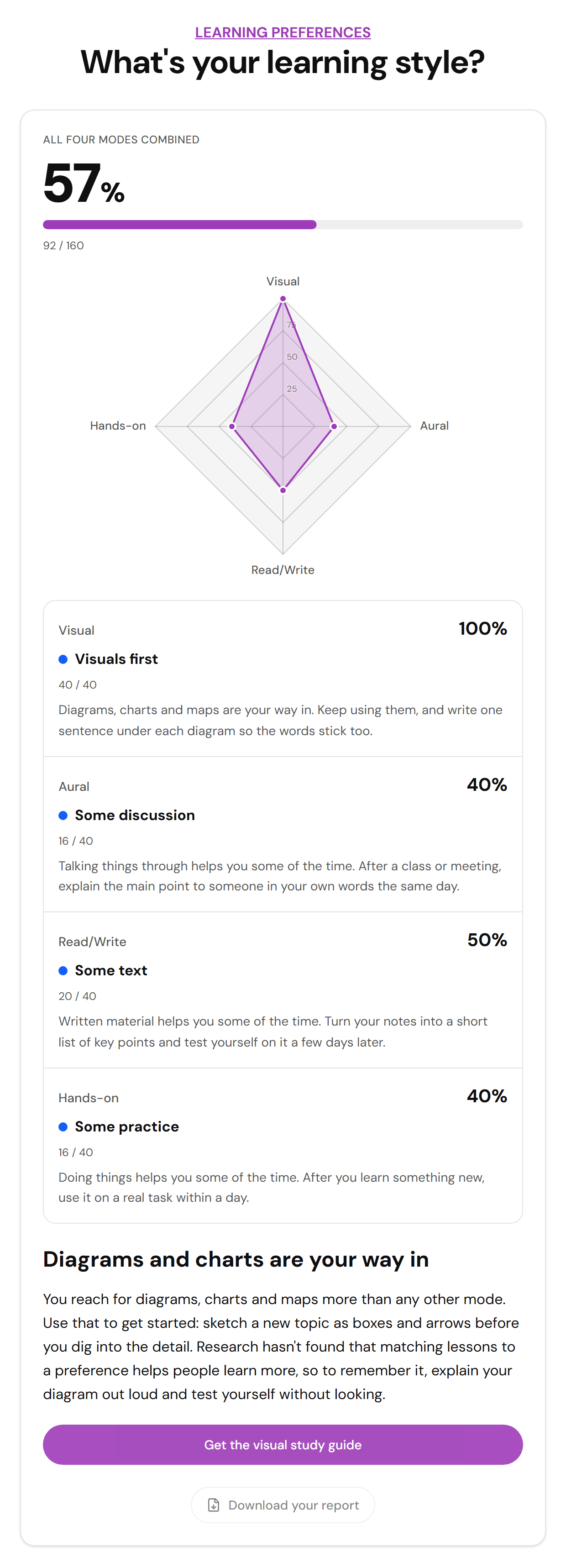
The quiz scores each preference from 0 to 100 percent. One preference wins when it reaches at least 40 percent and the other three stay at least one 10-point band below it, for example 50 percent or more while the others are under 40. If all four stay under 40 percent, the result is No clear preference. Anything else, usually two or more preferences close together at the top, is Multimodal.
Visual preference
Diagrams, charts and maps are your way in. Sketch a new topic as boxes and arrows before you dig into the detail, then explain the diagram out loud so it sticks.
Aural preference
Listening and talking things through work best. Ask questions and join the discussion, then write down the three main points afterwards and test yourself on them.
Read/Write preference
Written guides, lists and notes in your own words are your way in. Summarize what you read, then recall the points from memory instead of rereading.
Hands-on preference
You learn by doing. Try a practice task early, even before you feel ready, and note what worked after each try.
Multimodal
Your top preferences came out close together, which is common. Combining a diagram, an explanation and some practice tends to help people remember more than any single mode.
No clear preference
None of the four came out strong, so you are free to choose. Study one topic two ways and notice which one you still remember a few days later.
How the Scoring Works
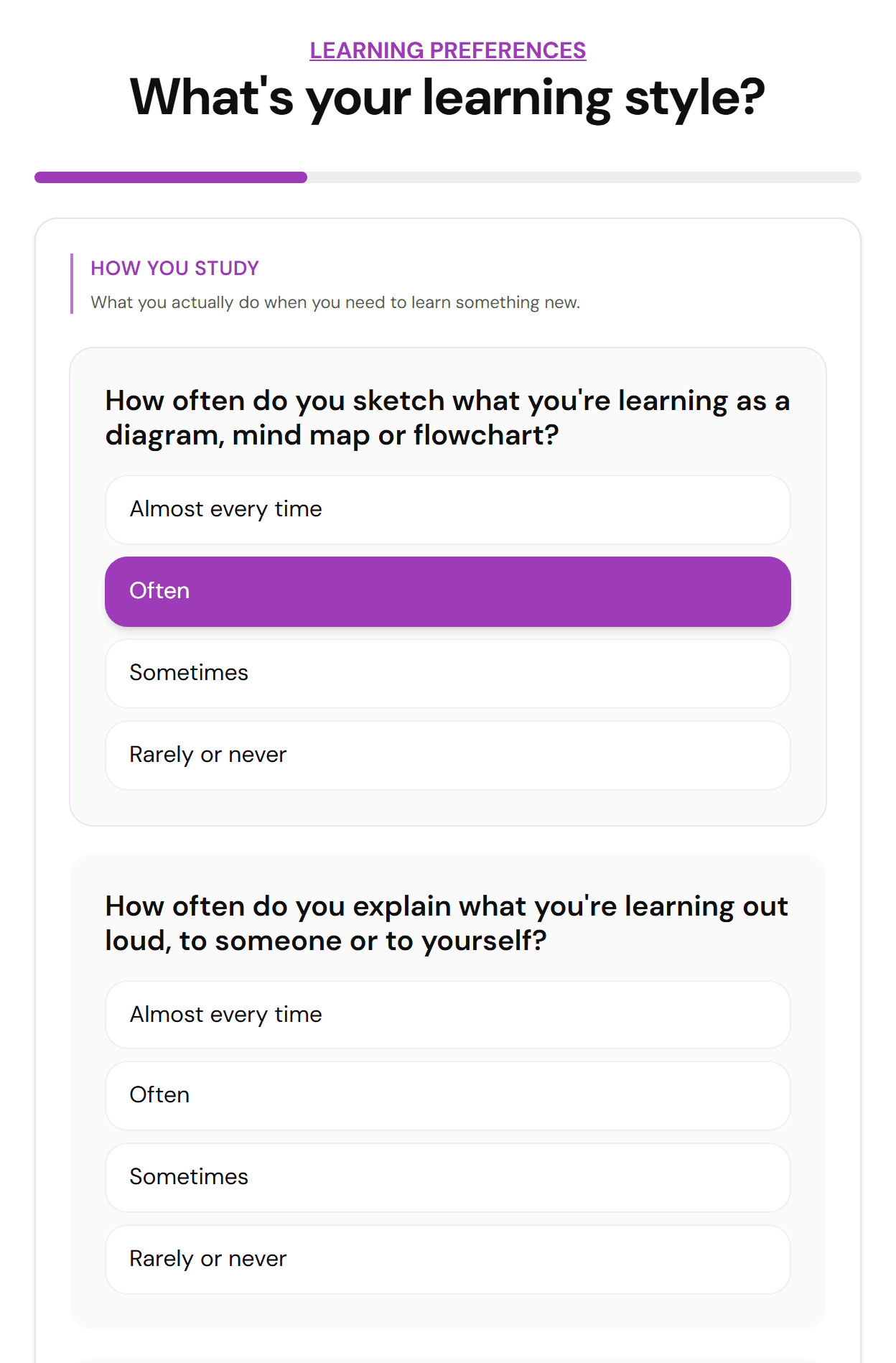
The quiz has three sections, each a situation: how you study, learning a new app, and a class or workshop. Each section asks one question per preference, so every preference gets three questions. Answers are worth 10, 7, 3 or 0 points, and the questions about how you study count double, because they ask what you actually do. That gives each preference up to 40 points, shown as 0 to 100 percent. Rating each kind of help on its own, instead of picking one answer out of four, shows how much you use every mode, not only your favorite.
Why Build It in FluoTest?
FluoTest is a free quiz builder made for scored assessments. You give each answer points in several categories at once, score visual, aural, read/write and hands-on side by side in one quiz, show the four scores as a radar chart, and use conditional outcomes that decide the result from how the scores compare, not just from one total.
If you run it with a class, a cohort or a course audience, every submission can email you the full score breakdown. The template already asks for a name and email before the result and emails each learner their result with a PDF report, so it works as a lead magnet as it is. Sync respondents to Brevo with their scores as contact attributes, or send results to Zapier, Make or n8n with a webhook.
Try it: fluotest.com
How to Build Your Own Learning Style Quiz in FluoTest
1. Start from the free learning style template
Duplicate the ready-made template. It already has 12 questions about three situations, four score categories and six outcomes, so you only edit the wording instead of building the scoring logic.
2. Choose three modes or four
The template scores all four VARK preferences. For a quick classroom quiz you can cut it down to visual, aural and hands-on: delete the Read/Write category, its three questions and its outcome, and take it out of the other outcome rules.
3. Ask about situations, not labels
"How much does a labeled diagram of the main screens help you?", asked about learning a new app, gets a more honest answer than "Are you a visual learner?". Pick a few everyday situations and ask how much each kind of help works in them: a written guide, a diagram, someone talking you through it, or trying it yourself.
4. Weight each answer toward one mode
Each question scores one preference: 10 points for the strongest answer, then 7, 3 and 0. Give double weight to the questions about how people actually study, so real habits count for more.
5. Set the outcome rules
Show a single-preference result when one preference reaches 40 percent and stays clearly ahead of the others, add No clear preference for when all four stay under 40 percent, and make Multimodal the default for everyone else. Order the outcomes so the specific ones are checked first.
6. Make every result useful
Give each result two or three concrete study tips and remind people to mix modes. If the quiz is a lead magnet, add a clear next step such as a free lesson, a course preview or a booking link. Each template result has a button for this, which stays hidden until you add your own link.
7. Share, embed and follow up
Send the link to a class, embed it on your site, or add it to course onboarding. The results email with a PDF report is already on, so learners keep their result. Connect Brevo or a webhook to follow up automatically.
Who Is This Quiz For?
- -Students and self-learners who want a quick, honest look at how they prefer to learn
- -Teachers running a first-week icebreaker or a study-skills lesson
- -Tutors and course creators who want a shareable lead magnet that ends in a clear next step
- -L&D and onboarding teams who want new hires to reflect on how they pick up new tools
- -Coaches who use learning preferences to shape their sessions
Frequently Asked Questions
What are the four learning styles?
In the VARK model the four styles are Visual, Aural (auditory), Read/write and Kinesthetic (hands-on). This quiz scores all four separately, so you see how much you use each one, not just your top style.
Are learning styles real?
Learning preferences are real, but research has not shown that teaching people only in their preferred style improves results. Use your result for self-reflection and combine modes when you study, for example by pairing a diagram with an explanation and some practice.
How long does the learning style quiz take?
About 2 to 3 minutes. It has 12 multiple-choice questions and needs no account. When you publish your own copy, it asks for a name and email before the result and emails each person their result with a PDF report.
What does a Multimodal result mean?
Multimodal means no single preference came out clearly ahead: two or more scored close together at the top. It is a common and useful result, because combining modes, such as a diagram, an explanation and some practice, tends to help people remember more. If all four preferences stay under 40 percent, you get No clear preference instead.
Can I use this quiz as a lead magnet for my course or tutoring?
Yes. Duplicate the template for free. It already asks for a name and email before the result and emails each learner their result with a PDF report. Add your own link to each result's button, such as a free lesson or a study guide, and connect Brevo or a webhook to send each learner's result into your follow-up.
Ready to build your own scored quiz?
FluoTest is free. No credit card required. Start in 5 minutes.
What you get with FluoTest:
- - Several independent score categories in one quiz
- - Conditional outcomes based on how the scores compare
- - Results emails for respondents and notifications for you
- - Brevo integration that syncs respondents with their scores
- - Webhooks for Zapier, Make and n8n
- - Per-question drop-off analytics
Questions? Read our pricing page or browse quiz templates.