Guide
Candidate Screening Tests: 8 Types, When to Use Each, and Free Templates
Most hiring teams know they should test candidates instead of trusting CVs. The hard part is choosing which test. A knockout questionnaire, a competency test, a culture fit assessment and an interview scorecard all answer different questions, and using the wrong one at the wrong stage costs you good candidates. This guide walks through the eight kinds of candidate screening tests, what each measures, where it fits in the hiring funnel, what the paid platforms charge for them, and a free template you can copy for each.
Quick answer
What types of candidate screening tests are there?
There are eight common types: an application screening questionnaire with knockout questions, a job knowledge test, a situational judgment test, a work sample test, a culture fit or values assessment, a soft skills or emotional intelligence test, a compliance or safety knowledge check, and a structured interview scorecard. Use the screening questionnaire at application, the knowledge, judgment and work sample tests on the shortlist, culture fit and soft skills to prepare the interview, the scorecard during it, and the compliance check at onboarding. FluoTest has a free template for every one of them.
Open the free job application screener template
What Is a Candidate Screening Test?
A candidate screening test is any structured, scored tool that helps you decide which applicants move to the next stage. Every candidate answers the same questions and every answer earns points, so you compare people on the same evidence instead of on how polished their CV looks. The score then drives a decision: advance, review by a person, or decline.
The term covers a wide family. Some tests screen for eligibility, such as the right to work or a required license. Some measure what a person knows or can do, often grouped under the name competency test or skills test. Some describe how a person works, such as culture fit or emotional intelligence assessments, and those should inform an interview rather than reject anyone. The sections below take each type in turn.
Which Tests Actually Predict Performance?
The 2022 meta-analysis by Sackett, Zhang, Berry and Lievens in the Journal of Applied Psychology ranked common selection methods by how well they predict job performance. Structured interviews came out on top, followed by job knowledge tests, work sample tests and situational judgment tests. Years of experience and unstructured interviews predicted very little.
That ranking is a useful guide for your screening stack. Spend your candidates' time on tests from the top of the list, keep the descriptive tests (culture fit, personality, emotional intelligence) as interview preparation, and turn the interview itself into a scored, structured one.
The 8 Types of Candidate Screening Tests
Each card says what the test measures, when to use it, the most common mistake, and which free FluoTest template to start from.
1. Application screening questionnaire
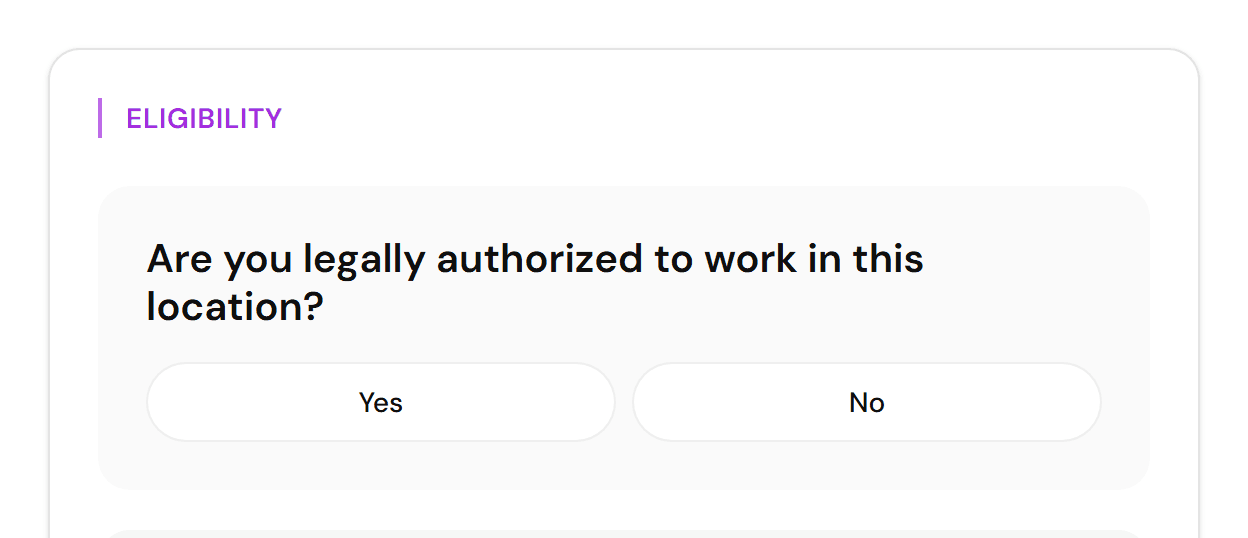
Measures: Hard requirements and must-haves: right to work, availability, required license, years of relevant experience, salary range. Knockout questions end the form politely when a dealbreaker is missed; the rest earn weighted points.
Best for: The application stage of any role with more than 30 applicants, especially support, retail, hospitality, sales and operations.
Watch out: Keep knockouts to true legal or logistical requirements. 'Five years of experience' is a preference, not a knockout, and it filters out people who could do the job.
2. Job knowledge test
Measures: Facts and procedures the person must know on day one: what a metric means, which ticket is urgent, which spreadsheet function to use. Multiple choice with a correct or best answer.
Best for: Shortlisted candidates for roles where domain knowledge is required at hire, not trained on the job.
Watch out: Do not test trivia that a new hire would learn in week one. Every question should map to a line in the job description.
3. Situational judgment test
Measures: How a candidate handles realistic trade-offs: speed versus quality, policy versus the customer in front of them, two urgent requests at once. Four responses per scenario, scored from best to worst.
Best for: Customer-facing, management and operations roles where judgment matters more than memorised knowledge.
Watch out: Base scenarios on real tickets, deals and incidents from the last few months. Invented dilemmas feel artificial and candidates spot the 'right' answer.
4. Work sample test
Measures: A small, real piece of the job: pick the best reply to an angry customer, spot the error on an invoice, choose the strongest subject line, write two sentences a customer will read.
Best for: The final shortlist for any role where the output can be shown in ten minutes or less.
Watch out: Keep it short and free of unpaid work. A 20-minute sample is fine; a full project brief is free labour and your best candidates will walk away.
5. Culture fit and values assessment
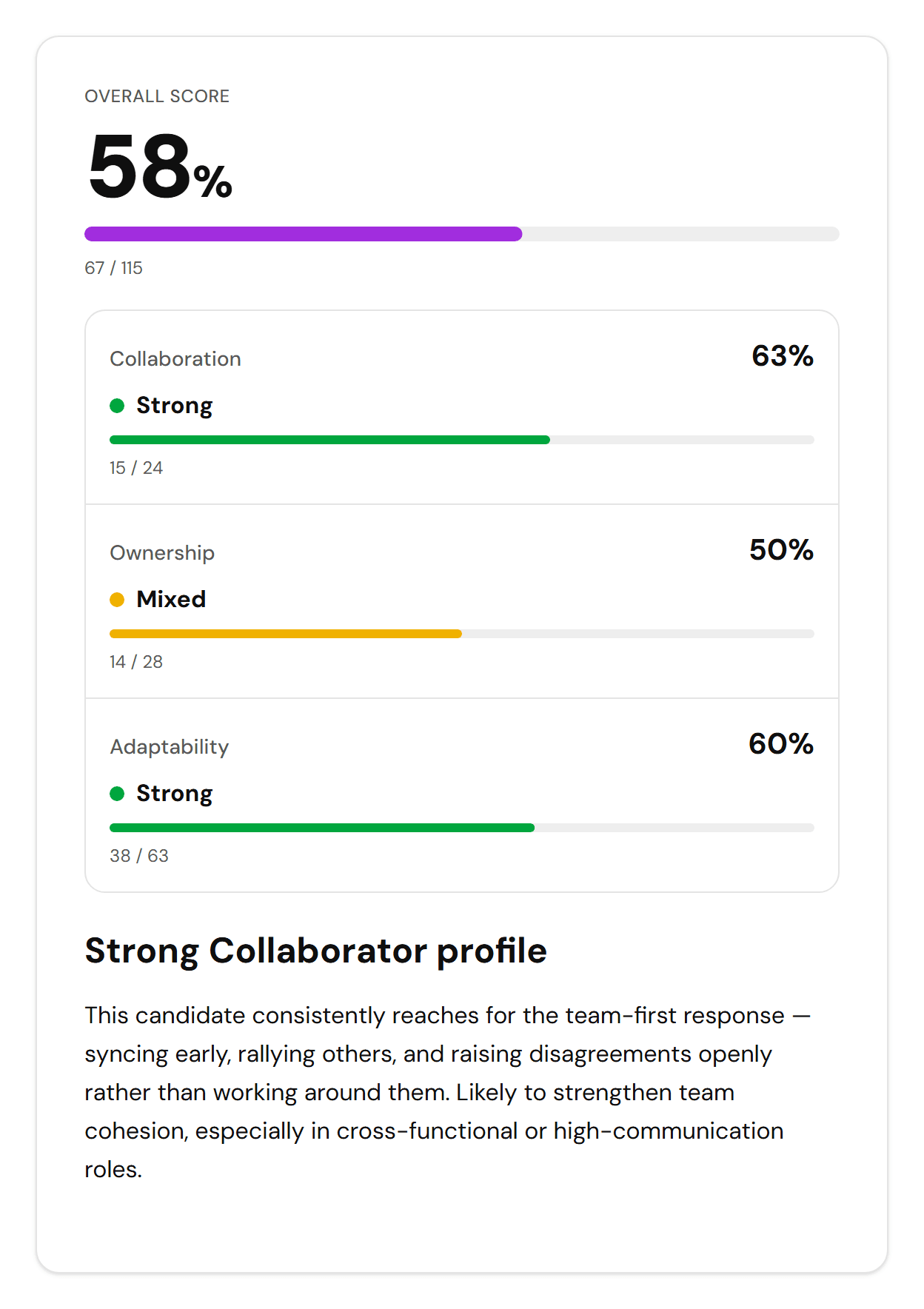
Measures: How a person prefers to work, scored across several dimensions at once, for example collaboration, ownership and adaptability. Each answer adds points to more than one dimension, so the result is a profile, not a pass mark.
Best for: Preparing a shortlist interview: the profile tells the interviewer which behaviours to probe.
Watch out: Never use it as a filter. 'Fit' used as a pass/fail test tends to reproduce the team you already have. Use it to ask better questions, and hire for what the team is missing.
6. Soft skills and emotional intelligence test
Measures: Self-awareness, self-regulation, empathy and social skills, usually from self-reported scenarios. Produces a per-dimension profile similar to a culture fit assessment.
Best for: Leadership, people-management, sales and support roles, as a conversation starter in the interview.
Watch out: Self-report answers are easy to game. Treat the result as the candidate's own view of their strengths, and verify it with a situational question in the interview.
7. Compliance and safety knowledge check
Measures: Required knowledge for regulated work: safety procedures, data handling, reporting rules. Pass/fail in points mode, with a retake path.
Best for: Security, healthcare, logistics, construction and finance roles, at offer or onboarding rather than at application.
Watch out: Set the pass mark where the regulation sets it, not where it feels fair. Log who passed and when; auditors will ask.
8. Structured interview scorecard
Measures: The interviewer's assessment of skills, experience, culture fit and motivation, scored on the same scale for every candidate, with a final eligibility check and a space for open concerns.
Best for: Every interview. It turns the strongest predictor of performance into something you can compare across interviewers.
Watch out: Fill it in during or immediately after the interview, before talking to colleagues. Scores written after a group debrief converge on the loudest opinion.
Which Test Belongs at Which Hiring Stage
Most hiring processes need three or four of the eight, not all of them. Here is a typical stack for a role with many applicants.
Application
Screening questionnaire with 1 or 2 knockouts
Cuts the pile on hard requirements in two minutes per applicant, without anyone reading CVs.
Shortlist (top 20 to 30%)
Job knowledge, situational judgment and a work sample in one 10 to 15 minute assessment
The three best predictors after the structured interview, scored as separate categories so you see where each candidate is strong.
Before the interview
Culture fit or emotional intelligence profile
Gives each interviewer two or three behaviours to probe. Not a filter.
Interview
Structured interview scorecard, one per interviewer
Same criteria and scale for everyone, so the debrief compares scores instead of impressions.
Offer and onboarding
Compliance or safety knowledge check
Only where regulation requires it. Pass/fail, with a retake.
What Candidate Screening Tests Cost
Dedicated assessment platforms charge by seat and by candidate volume. TestGorilla's assessment plans, checked on testgorilla.com/pricing on 2026-10-08, are a free plan with 10 credits a month and 5 essential tests, Core from $215 a month billed annually, and Plus from $520 a month billed annually, all in USD. Their test library is the main thing you pay for.
| Plan | Price | What you get |
|---|---|---|
| TestGorilla Assessments Free | $0 | 10 credits a month, 5 essential tests (checked 2026-10-08) |
| TestGorilla Assessments Core | from $215 a month, billed annually | Full 350+ test library, 2 premium user roles |
| TestGorilla Assessments Plus | from $520 a month, billed annually | Premium tests, custom questions, job simulations |
| FluoTest | Free | Unlimited quizzes and responses, scoring, knockouts, outcomes, email notifications. Fair-use policy applies. |
If you write your own questions, which you should for job knowledge, situational judgment and work sample tests anyway, you do not need the library. FluoTest is free for unlimited quizzes and responses, with per-answer points, score categories, knockout questions and automated routing included. The eight templates in this guide are a starting point, not a paywall.
Keep Screening Tests Fair and Legal
The same rules apply to every type:
- -Test only what the job needs. If you cannot explain why a question predicts performance in this role, remove it.
- -Give every candidate the same test, the same time and the same scoring. Randomising answer order is fine; changing questions per person is not.
- -Keep a person in the loop. Let the score sort candidates, but have a human confirm every decline. Under GDPR Article 22, people have the right not to be subject to decisions based solely on automated processing when those decisions significantly affect them.
- -Tell candidates what is scored, who sees it and how long you keep it before they start, and never ask about health, religion, ethnicity or other special-category data.
Full GDPR and fairness checklist in the pre-employment assessment guide
Why Build Your Screening Tests in FluoTest?
FluoTest is a free quiz builder for scored assessments. Every answer earns points in one or more categories, so a single test can score job knowledge, judgment and work sample side by side, or produce a three-dimension culture fit profile. Yes/no questions can be marked as disqualifiers, and outcomes route each candidate to advance, review or decline based on the score. Hide the score from candidates so they see a neutral thank-you while your team gets the full breakdown.
Submissions can email your hiring team every answer, including open work-sample responses and resume uploads, and reach your ATS or a spreadsheet through a webhook to Zapier, Make or n8n. Interviewers can fill the scorecard on their phone. All eight templates in this guide are free to copy.
Try it: fluotest.com
See our pricing page · Open the free job application screener template · Open the culture fit assessment template
How to Build Your Screening Stack in 5 Steps
1. Write down what the job needs in its first 90 days
Pick two or three hard requirements for the knockouts and three to five skills for the assessment. Everything you test should trace back to this list.
2. Start from the matching templates
Copy the job application screener for the application stage and the pre-employment skills assessment for the shortlist. Add the culture fit assessment and the interview scorecard if you run interviews with more than one person.
3. Rewrite the questions with real material
Replace the sample scenarios with actual tickets, deals, invoices or incidents from the last quarter. Keep each test to 10 to 15 minutes.
4. Set tiers and hide the score
Start with 75% to advance, 50 to 74% for human review and below 50% as below the bar, then adjust after your first 20 candidates. Turn on hidden scores so candidates see a neutral message.
5. Route results to a person
Email the hiring team each submission or push it to your ATS with a webhook. Advance the top tier, review the middle by hand, and have a person confirm every decline.
Who Should Use Candidate Screening Tests?
- -HR teams and recruiters handling high-volume roles in support, sales, retail, logistics and operations
- -Recruitment and staffing agencies that want to send clients a scored shortlist instead of a pile of CVs
- -Small businesses without an HR department that need a consistent way to compare applicants
- -Hiring managers who interview with colleagues and want one scorecard for everyone
- -Teams in regulated industries that must document a compliance or safety check before someone starts
Frequently Asked Questions
What are the main types of candidate screening tests?
Application screening questionnaires with knockout questions, job knowledge tests, situational judgment tests, work sample tests, culture fit or values assessments, soft skills and emotional intelligence tests, compliance and safety knowledge checks, and structured interview scorecards. Most hiring processes use three or four of them.
What is a competency test in recruitment?
A competency test measures whether a candidate can do the work: it combines job knowledge questions, situational judgment scenarios and a work sample into one scored assessment. It is different from a personality or culture fit assessment, which describes how someone prefers to work and should not be used as a pass/fail filter.
How many tests should a candidate take?
As few as possible for the decision you need. A typical stack is a two-minute screening questionnaire at application, one 10 to 15 minute assessment for the shortlist, and a scorecard filled in by the interviewer. Adding more tests mostly adds drop-off among your strongest candidates.
Can I use a culture fit test to reject candidates?
You should not. Culture fit and emotional intelligence results are self-reported profiles, not pass/fail scores. Use them to prepare interview questions and to hire for what the team is missing, and base rejections on job-related skills evidence.
Are there free candidate screening tests?
Yes. FluoTest is free for unlimited quizzes and responses and includes templates for every type in this guide: a job application screener, a pre-employment skills assessment, a culture fit assessment, an emotional intelligence test, a compliance knowledge check and a candidate screening scorecard. You write the questions for your role; the scoring and routing are already set up.
Are candidate screening tests legal in the EU?
Yes, when they are job-related, applied consistently and transparent. Tell candidates what is scored and how it is used, avoid special-category data, and keep a human involved in every rejection decision as GDPR Article 22 expects. For specific cases, check with an employment lawyer in your country.
Build your candidate screening tests today
FluoTest is free. No credit card required. Eight templates ready to copy.
What you get with FluoTest:
- - Knockout questions with a polite, specific message
- - Points per answer and separate score categories
- - Multi-dimension profiles for culture fit and soft skills
- - Hidden scores for candidates, full breakdowns for your team
- - Email notifications with every answer and uploaded CV
- - Webhooks for Zapier, Make and n8n
Questions? Read our pricing page or browse quiz templates.